The first thing the waterfall takes is your argument.
You may arrive with theories. About resilience, about nervous-system regulation, about the medicinal romance of cold water. You may arrive with a private little speech prepared, something modern and polished about discomfort as portal. But then the water falls. It does not negotiate. It does not care that you have read about breathwork. It lands on the shoulders with the blunt force of weather before language.
This is takigyo, a Japanese waterfall purification practice often associated with misogi, the broader Shinto act of cleansing the body and spirit with sacred water. In some places, it is practiced as mountain ascetic training. In others, it is offered through temples, shrines, or guided local experiences to visitors seeking something more bracing than a spa treatment and more ancient than a trend.
To call it "cold plunge" is technically adjacent and spiritually inadequate. A cold plunge asks you to endure water. Misogi asks you to become honest inside it.
The Ritual Before the Water
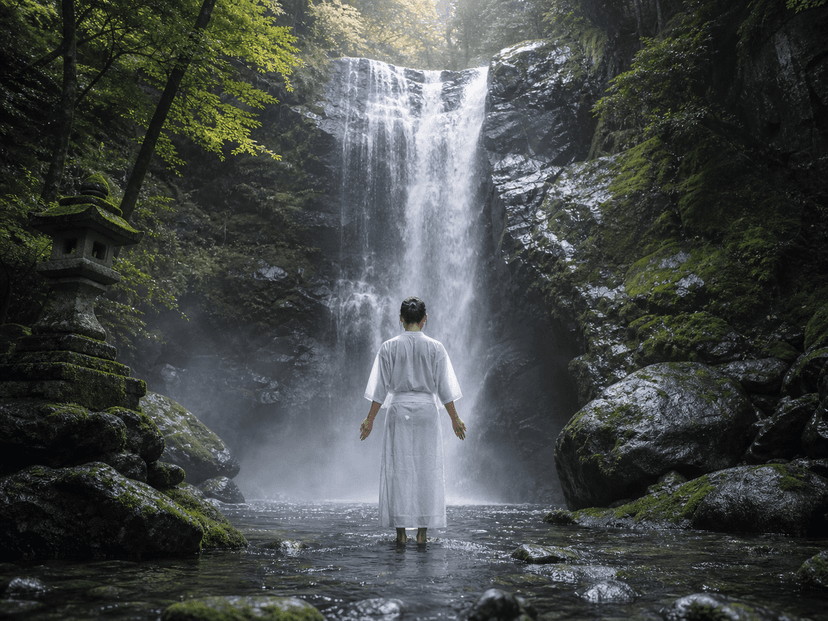
In guided takigyo, the waterfall is rarely approached casually. There is preparation. A change into white clothing. A prayer or salutation. Sometimes chanting, sometimes breath, sometimes a sequence of gestures to focus the mind before the shock arrives. The details vary by location, sect, and teacher, but the structure matters: the body is not merely entering cold water. It is entering permission.
The white garments are not fashion. They are symbolic reduction. Status stripped away. No tailoring, no performance, no flattering silhouette. Just the body, the breath, and the mountain's indifferent plumbing.
At Shirataki Daimyojin in Mie Prefecture, the practice is described as both purification and prayer: a way to wash away distracting thoughts, strengthen the spirit, face the divine, and reconnect with the natural world. The Japan National Tourism Organization describes takigyo at Shirataki Falls as a centuries-old meditation tradition tied to Japanese mountain worship.
That is the first correction misogi offers modern wellness: this is not self-care as self-improvement. It is self-care as surrender to something older, colder, and less interested in your metrics.
The Moment Beneath the Falls
Under the waterfall, there is no multitasking.
The mind, usually so gifted at producing side commentary, becomes briefly unemployed. The water is too loud. The cold too immediate. The body, startled into seriousness, narrows its attention to breath, balance, and staying upright beneath a force that feels at once violent and strangely clean.
This is part of the appeal. Not comfort. Not luxury. Not even calm, at least not at first. The ritual begins as disruption. The old noise is interrupted by a larger noise.
In the West, wellness often arrives padded: soft robes, warm towels, ambient music, a cucumber floating nearby like a tiny green witness. Takigyo offers no such diplomacy. It says: stand here. Bow. Breathe. Be hit by the world until the smaller anxieties lose their volume.
The water does not solve your life. It simply makes several of your concerns seem overdressed.
Misogi and the Meaning of Purification
Misogi is commonly understood as ritual purification through water, closely related to harae, another form of purification in Shinto practice. The point is not merely hygiene. It is the clearing of spiritual impurity, mental clutter, and the invisible residue of contact with the world.
This distinction matters. Modern wellness has a habit of turning every ritual into a tool: for productivity, sleep, inflammation, leadership, skin, libido, longevity. Ancient practices get dragged into the fluorescent light of optimization and asked to prove their quarterly value.
Misogi resists that, or should. Its power is not that it gives the body a clever hack. Its power is that it asks the body to participate in meaning.
Water cleans because water removes. Sweat, dust, heat, thought, pride. Under a waterfall, purification is not metaphorical enough to remain polite. It becomes physical. The body understands before the mind catches up.
The Nervous System Meets the Sacred
Of course, the modern mind wants to explain the afterglow. Cold water can provoke a dramatic physiological response: gasp reflex, heightened alertness, a rush of sensation, changes in breathing and circulation. Some people emerge feeling sharpened, euphoric, or strangely quiet.
But takigyo is not reducible to the chemistry of shock. The setting changes the experience. A forested ravine. A priest or guide. A bow before entering. The sound of water hitting stone. The knowledge that others have stood there before you, not to optimize their morning routine, but to humble themselves before nature and prayer.
Context is not decoration. Context is medicine of another kind.
The same water in a hotel plunge pool says one thing. The same cold beneath a sacred waterfall says another. One is recovery. The other is reckoning.
Why It Travels So Well Online
It is easy to see why takigyo has become magnetic to outsiders. The image is irresistible: white robes, dark stone, water like a blade, a person standing in the middle of it all trying not to flinch. It photographs like transformation.
And that is precisely where care is required.
Rituals lose something when treated as extreme tourism with better lighting. Takigyo is not a dare. It is not a content prompt. It is not the spiritual cousin of a viral ice bath challenge. To approach it well is to approach it with instruction, humility, and the awareness that sacred practices do not exist merely to make the visitor feel cinematic.
The best versions of The Wild Well are not about collecting rituals like souvenirs. They are about asking what a practice reveals about the culture that carries it, and what parts of ourselves become visible when comfort is removed.
Who Should Not Romanticize It
Cold-water exposure can be risky. The shock can be intense, especially for people with heart conditions, blood pressure concerns, respiratory issues, limited cold tolerance, or anyone entering moving water without proper supervision. Waterfalls are not wellness props. They are powerful natural environments.
If takigyo is practiced, it should be done through a legitimate guide, shrine, temple, or local organization with clear safety protocols. The point is not to prove bravery. The point is to enter a ritual correctly enough that bravery becomes almost beside the point.
There is no enlightenment in being careless.
What the Water Leaves Behind
People often describe leaving the waterfall altered. Not permanently, perhaps. Not in the way wellness marketing promises, with a new self emerging fully edited and ready for morning routines. More subtly. The body warms again. The breath slows. The ordinary world returns, but with sharper edges.
After misogi, a cup of tea is not just tea. A towel is not just a towel. The first dry layer against the skin feels almost ceremonial. You notice how much of daily life is buffered, softened, negotiated on your behalf.
The waterfall removes that negotiation for a moment.
And maybe that is the lesson. Not that suffering is noble. Not that cold is magic. Not that ancient rituals exist to rescue modern people from their calendars.
The lesson is simpler and harder:
Some clarity cannot be coaxed.
It has to arrive all at once.
Heavy.
Freezing.
From above.
Sources
This article draws on Japan National Tourism Organization material on takigyo waterfall meditation at Shirataki Falls, Shirataki Daimyojin's description of misogi and its waterfall purification ritual, and JNTO's overview of guided takigyo meditation at Bentendo Waterfall.