In a shaded room in northern Sudan, the smoke begins to rise.
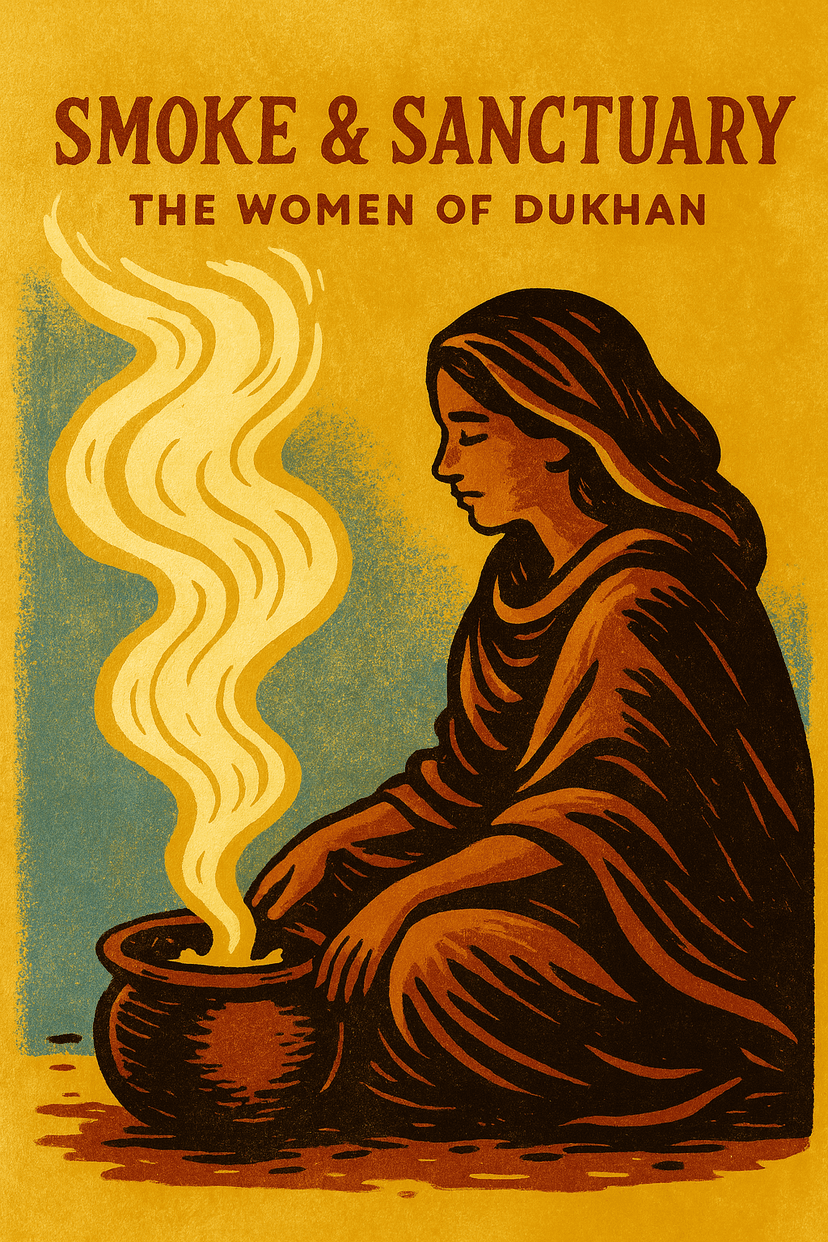
A woman sits wrapped in a thick woolen shawl. Beneath her, a small clay brazier—called a kanoun—glows with the embers of scented wood. Shafts of smoke rise through the folds of her garment, curling around her skin. Outside, the desert air hums with silence. Inside, the ritual begins.
This is Dukhan: one of the oldest and most elemental wellness practices in the world. Part smoke bath, part postnatal therapy, part ceremonial beautification, Dukhan is what happens when women inherit the fire—and learn to wield it for transformation.
What Is Dukhan?
Dukhan (Arabic: دخان, literally "smoke") is a traditional Sudanese smoke therapy ritual practiced primarily by women—often during key life transitions: before marriage, after childbirth, or as a regular self-care ritual throughout adulthood.
At its core, Dukhan is simple. A woman sits or squats over a slow-burning pit of aromatic wood—typically talh (acacia), shaff, or sandalwood—while her body is enclosed in a thick woolen blanket (shamla), trapping the smoke around her skin.
But this isn't just a steam session. It's a full-body sensory ceremony: scent, heat, sweat, and quiet. Often preceded by karkar, a perfumed oil massaged into the body, and followed by dilka, a fragrant exfoliating scrub, the entire experience can last hours.
A Ritual of Beauty and Power
In Sudanese culture, Dukhan is considered both aesthetic and sacred. The smoke softens the skin, imparts a subtle golden glow, and leaves the body scented for days. Many women undergo it before weddings to prepare their bodies not just for beauty, but for intimacy—both physical and energetic.
"Dukhan isn't just about appearance," one Sudanese bride told Chapter Z Magazine. "It's about stepping into a new phase. You emerge glowing—not just outside, but inside too."
In postnatal care, Dukhan is believed to tighten muscles, promote healing, and purify the womb. In traditional medicine, it was also used to ease symptoms of joint pain, fatigue, even STIs—its antiseptic properties enhanced by the oils and herbs blended into the smoke.
And yet, its power has always been more than functional. It's an inheritance—a ritual passed from mothers to daughters, aunties to nieces, sometimes whispered between women over lifetimes.
The Ceremony, Step by Step
A proper Dukhan session can be broken down into phases:
Preparation
The woman bathes and exfoliates.
Karkar oil—made from sesame, cloves, and sandalwood—is applied generously to her skin.
A kanoun brazier is lit with aromatic woods.
Enclosure
She squats over the brazier.
A heavy shamla (blanket) is draped over her shoulders, enclosing the smoke around her body.
She remains in place for 10–30 minutes, sometimes longer.
Emergence
She steps out, glistening and flushed.
The room fills with scent—clove, wood, sesame, skin.
A dilka scrub follows: scented powder massaged into the skin, then rinsed, leaving her radiant and warm.
More Than Skin Deep
Though Dukhan may seem cosmetic at first glance, its psychological and social layers run deep. In many Sudanese households, it is a space where women gather, speak, grieve, plan, advise. Smoke becomes the medium for both scent and story.
In a world where so many wellness rituals are solitary, Dukhan remains communal. It's wellness not for escape, but for reconnection—with lineage, sensuality, and shared memory.
Health + Heat: What Science Says
Modern researchers are taking notice. A 2021 study in the Journal of Ethnopharmacology documented Dukhan's widespread use in Sudan and acknowledged its thermotherapy and aromatherapy components as valuable for muscle relaxation and circulation. However, it also flagged potential concerns around smoke inhalation and genotoxicity—especially with excessive or poorly ventilated use.
As with many traditional therapies, the value lies in moderation, context, and intention. And in Dukhan, those elements are built into the ritual itself.
The Aesthetics of Fire
What makes Dukhan special is not just the heat—it's the elegance of the process. The textures. The smell. The unhurried rhythm. In many ways, it's the antithesis of modern self-care: there are no apps, no timers, no optimization hacks.
There is only:
a woman,
a bowl of embers,
a sacred blanket of scent.
A Ritual Worth Remembering
In recent years, Dukhan has made small appearances in global beauty circles—appearing in Vogue Arabia and niche ethnobotanical wellness columns. But its roots remain deeply local, deeply private. It is not for mass export. It is not for Instagram.
It is a ceremony for those who understand that true wellness is not about appearance—it's about anchoring. Dukhan doesn't just beautify. It grounds. It returns you to the body—the actual body, not the virtual one.
Closing Thought: The Woman in the Smoke
Imagine her now—half-shrouded, wrapped in wool, seated in silence while smoke weaves around her like memory. She is not rushing. She is not scrolling. She is being prepared—for life, for love, for herself.
This is Dukhan. Smoke not as escape. Smoke as becoming.