The new luxury is not comfort.
It is discomfort with better towels.
Somewhere in a very calm room, a man in a white robe is being told that the best thing he can do for his health is become briefly miserable.
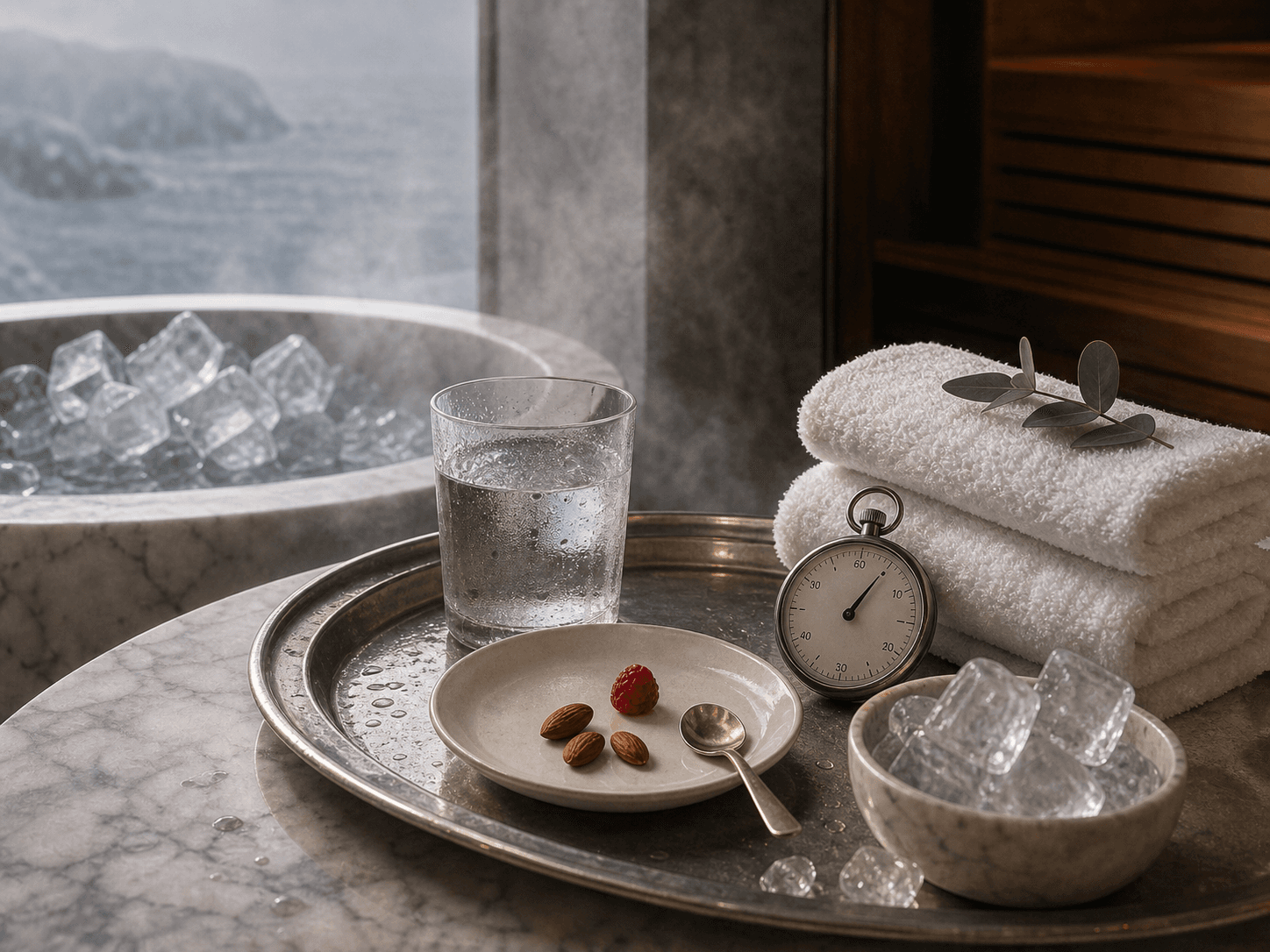
There is a marble cold plunge. There is a sauna humming with Nordic moral authority. There is a plate nearby containing three almonds, a quarter of a fig, and a berry arranged with the confidence of a gallery installation. The man has paid a shocking amount of money to be cold, underfed, and spoken to in the soothing voice normally reserved for estate planning.
He is not unhappy, exactly.
He is becoming optimized.
The Prestige of Voluntary Discomfort
For most of human history, being cold and hungry was not a lifestyle product. It was winter. It was scarcity. It was a problem to solve with shelter, food, and ideally someone competent in the family.
Modern affluence has performed a neat little reversal. Once comfort becomes too available, discomfort becomes interesting again. Not ordinary discomfort, of course. Not a broken heater, a delayed flight, or lunch forgotten in the office refrigerator. Curated discomfort. Scheduled discomfort. Discomfort with a cedar bench, a mineral electrolyte packet, and a person named Anders explaining vagal tone.
This is not entirely foolish. That is what makes it such good theater.
The body does respond to stress. Temperature, nutrient timing, exercise, heat, and recovery all speak to ancient systems of adaptation. The comedy begins when a real biological idea is dressed in a robe, placed beside a $42 bottle of structured water, and encouraged to develop a brand voice.
Why Cold Became Expensive
Cold exposure has a legitimate scientific hook: thermoregulation. Humans have brown adipose tissue, a metabolically active fat that can help generate heat. Studies have shown that cold exposure can activate brown fat and change glucose and fatty acid uptake in adults. This is not imaginary. The body really does notice when you put it in cold water and ask it to remain polite.
But the leap from "cold exposure activates interesting metabolic pathways" to "this plunge will repair your life, your mitochondria, and your relationship with your father" is where the wellness economy begins humming its expensive little hymn.
Human responses to cold are messy. They vary by body composition, acclimation, sex, baseline metabolic health, exposure type, duration, and whether the person is shivering with stoic purpose or simply regretting the purchase. Reviews of cold exposure and metabolism are full of potential, but also full of heterogeneity, which is science's way of saying: please stop making the Instagram caption do all the work.
Cold is not magic. It is a stimulus. A stimulus is not a personality.
Why Hunger Got Rebranded
Fasting has a similarly legitimate core. Periods without food can shift metabolism from readily available glucose toward stored fat and ketone production. Researchers such as Rafael de Cabo and Mark Mattson have written about intermittent fasting in relation to metabolic switching, stress resistance, aging biology, and disease risk.
This is genuinely fascinating. It is also not a universal permission slip to skip breakfast and become unbearable by 11:15.
Human trials of time-restricted eating have produced mixed and context-dependent results. Some show benefits when eating windows are earlier or when the protocol helps reduce total intake. Others show modest weight changes or no major advantage over ordinary meal timing when calories and behavior are not otherwise improved. The boring truth is that timing matters, calories matter, adherence matters, sleep matters, muscle matters, and the body remains deeply uninterested in your preferred narrative arc.
Fasting can be a tool. It can also become a socially acceptable way to turn lunch into a character test.
The Tiny Breakfast as Status Symbol
The luxury wellness breakfast is one of civilization's funniest objects.
It arrives on stoneware. It contains seeds from several tax brackets. There is yogurt, but not enough to create comfort. There is fruit, but it has been edited. There is often a leaf placed beside something that did not ask for garnish. The whole arrangement seems less designed to feed a person than to reassure them that appetite has been placed under tasteful management.
This is where wellness reveals its class dimension. Hunger is unpleasant when it is imposed. It becomes sophisticated when it is chosen, named, timed, and paired with a view.
The wealthy do not merely avoid discomfort. They purchase the right to re-enter it symbolically, safely, and with excellent ceramics.
The Biology Is Real. The Performance Is Also Real.
This is the important part: laughing at the ritual does not mean dismissing the biology.
Cold exposure, heat exposure, fasting, exercise, and sleep all interact with systems the body uses to adapt. Hormesis, the idea that controlled stress can provoke beneficial adaptation, is a serious concept when handled carefully. The body does not become stronger because life is effortless. It becomes stronger when stress and recovery are dosed well enough to invite adaptation rather than injury.
But the dosing is the whole point. More suffering is not automatically more health. A cold plunge is not morally superior to a walk. A fasting window is not proof of discipline if the rest of the day is chaos with supplements. A sauna cannot absolve an inbox, though many have entered one hoping otherwise.
The wellness industry is very good at turning plausible signals into identity. First you try the thing. Then you buy the robe. Then you say "metabolic flexibility" in a tone that damages a brunch.
Why We Still Want It
Of course we want it.
We want the retreat. We want the towels. We want the view through steam. We want the feeling that our bodies are not merely surviving our lives but being attended to by a small committee of attractive professionals with excellent boundaries.
There is something moving inside the absurdity. Beneath the cold plunge face and the microscopic breakfast is a real desire to feel less inflamed by modern life. To sleep better. To age with more dignity. To stop confusing stimulation with vitality. To have one morning where the nervous system is not being chased through a parking lot by email.
The desire is sincere. The packaging is ridiculous. Highest Fade lives in that gap, wearing slippers.
The Sensible Version, Unfortunately
The least glamorous version of this story is probably the most useful. Move often. Build muscle. Sleep like it matters. Eat enough protein and plants. Leave time between some meals if that suits your body and life. Use cold or heat carefully if you enjoy them, and avoid turning either into a moral credential.
If you have medical conditions, a history of disordered eating, cardiovascular risk, pregnancy, medication timing issues, or anything that makes "just plunge and fast" sound suspiciously like advice from a man with a podcast microphone, talk to a clinician before experimenting.
The human body is not impressed by branding. It responds to inputs, constraints, recovery, consistency, and luck.
Still, if the cold plunge is there, and the towel is warm, and someone has placed cucumber water within reach, you may step in. You may hiss. You may tell yourself this is mitochondrial renewal. You may be partly right.
The trick is to know when you are improving your health
and when you are simply being baptized into a nicer invoice.
Sources
This essay draws on peer-reviewed research and reviews on cold exposure, brown adipose tissue, time-restricted eating, and intermittent fasting. It is cultural commentary, not medical advice.
- Brown adipose tissue oxidative metabolism contributes to energy expenditure during acute cold exposure in humans
- Cold exposure and human metabolism: a heterogeneous response across tissues and organs
- JAMA Internal Medicine: early time-restricted eating randomized clinical trial
- JAMA Internal Medicine: TREAT randomized clinical trial of time-restricted eating
- New England Journal of Medicine: Effects of intermittent fasting on health, aging, and disease