Aging is not only what the body loses.
Sometimes it is what the body forgets to remove.
Deep inside the cell, mitochondria live under pressure. They burn fuel, leak signals, make energy, absorb stress, and age with the quiet dignity of machinery left running too long in a warm room.
In youth, the cell is ruthless about maintenance. Damaged mitochondria are tagged, dismantled, and cleared through a process called mitophagy. It is not glamorous. It is not biohacking. It is housekeeping at molecular scale.
But with age, the cleanup slows. The tired mitochondria linger. The room fills with bad furniture. Energy production becomes less elegant. Inflammatory signals rise. The cell begins to look less like a well-run atelier and more like a storage unit with lighting.
This is where urolithin A becomes fascinating.
A Molecule You Do Not Quite Eat
Urolithin A is not simply hiding inside pomegranates, waiting to be discovered by a luxury wellness label. The story is stranger.
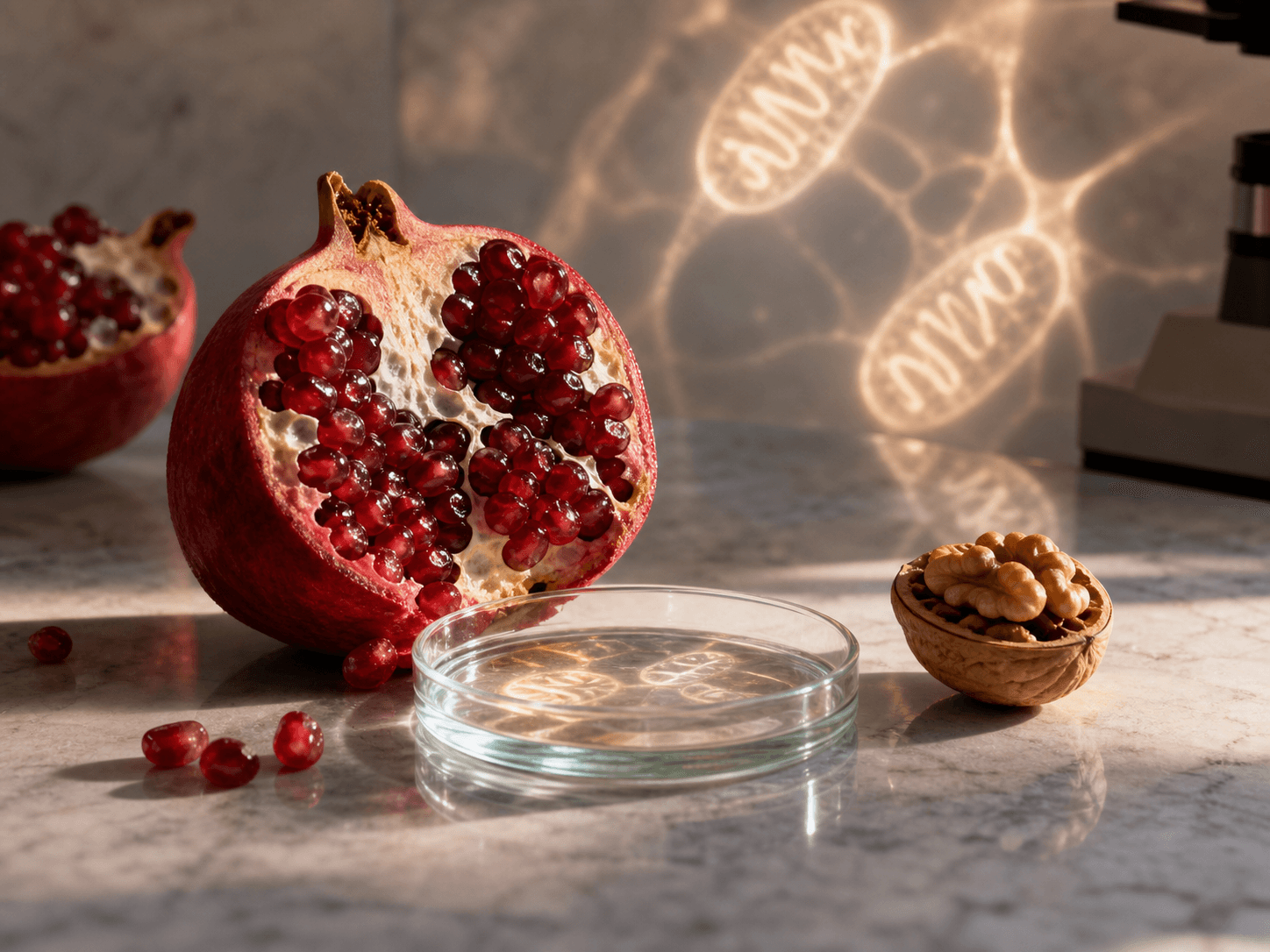
Pomegranates, walnuts, and some berries contain ellagitannins and ellagic acid. Your gut microbes may convert those compounds into urolithin A. May is the important word. Not every microbiome does this efficiently. Two people can eat the same pomegranate and leave the meal with different biochemical souvenirs.
This is already more interesting than most supplement stories. The molecule is not just a nutrient. It is a negotiation between food and the private ecology of the gut.
You do not merely consume it. Under the right microbial conditions, you manufacture it.
The Art of Taking Out the Mitochondrial Trash
In a 2016 Nature Medicine paper, researchers reported that urolithin A induced mitophagy and extended lifespan in C. elegans, a tiny worm beloved by aging scientists because it ages quickly, plainly, and without needing much office space.
In rodents, the same line of research found improved muscle function. That does not mean a pomegranate is a time machine. It means the molecule appeared to activate a conserved cleanup pathway, one tied to mitochondrial quality control.
The elegance is in the mechanism. Urolithin A is not trying to force the cell into more output. It is not shouting for energy. It is asking the cell to remove what has become inefficient.
Longevity science often worships production: more ATP, more performance, more measurable vitality. Urolithin A points to a quieter truth. Sometimes the body does not need more. It needs fewer broken parts left in the room.
Human Data, Carefully
The human research is promising, but should be kept in proportion. A 2019 Nature Metabolism study reported that urolithin A was bioavailable and safe in older adults, and that supplementation produced molecular signatures consistent with improved mitochondrial and cellular health.
Later clinical work has explored muscle endurance, muscle strength, and biomarkers tied to mitochondrial function and inflammation. A more recent Nature Aging study looked at immune aging markers in middle-aged adults and reported changes suggesting improved mitochondrial quality and immune function.
That is not immortality. It is not reversal. It is not a permission slip to replace sleep with capsules.
It is something more subtle, and perhaps more useful: evidence that a molecule connected to the gut and diet can influence one of aging's most intimate maintenance systems.
Why This Feels Different From the Usual Longevity Theater
Most longevity trends arrive dressed as conquest. Beat aging. Hack aging. Reverse aging. Outperform aging. The language is masculine in the least interesting way, all dashboards and domination.
Mitophagy offers a better metaphor.
It is custodial. Domestic. Almost tender. The cell looks inward and asks what must be cleared so the rest can function.
This is not the fantasy of becoming invincible. It is the discipline of remaining habitable.
A body that ages well may not be one that never breaks. It may be one that continues to notice what has broken, and knows how to remove it before the whole house starts smelling faintly of neglect.
The Pomegranate Problem
Of course, the pomegranate has already been mythologized enough. Persephone, fertility, blood, luxury hotel breakfast buffets. It does not need more symbolic employment.
Still, the image is hard to resist. Ruby seeds. Bitter membrane. A fruit that makes you work for sweetness. Inside it, not urolithin A exactly, but the possibility of a molecule your microbes might make if the internal conditions are right.
That caveat is the beauty. Longevity is not only about what you ingest. It is about what your internal world is capable of transforming.
The same meal can become different chemistry in different people. The body is not a blender. It is an ecosystem with opinions.
What We Should Not Pretend
Urolithin A is not a miracle. It is not proof that supplements can outrun bad sleep, loneliness, alcohol, or a life lived under fluorescent stress. The human trials are still bounded: specific doses, specific populations, specific endpoints, limited timeframes.
The correct response is not worship. It is attention.
In the crowded theater of anti-aging, urolithin A earns attention because it is narrow, mechanistic, and biologically plausible. It does not promise a new self. It points to an old housekeeping process and asks whether we can help it remember its job.
Closing Thought: The Luxury of Maintenance
There is a strange dignity in maintenance. In clearing, pruning, repairing, removing. Not everything old needs to be replaced. Some things need to be tended so the living parts can breathe.
This is what makes urolithin A so compelling. It is not a glamorous molecule in the obvious sense. It does not sparkle. It does not seduce with speed. It enters the story quietly, through fruit and microbes and mitochondrial debris.
Then it does something almost unfashionable.
It helps clean.
And perhaps that is one of aging's deepest lessons: beauty is not only preservation.
It is disposal, done well.
Sources
This essay draws on primary and peer-reviewed research on urolithin A, mitophagy, mitochondrial health, and aging-related biomarkers.
- Nature Medicine: Urolithin A induces mitophagy and prolongs lifespan in C. elegans and increases muscle function in rodents
- Nature Metabolism: Urolithin A is safe and induces a molecular signature of improved mitochondrial and cellular health in humans
- Cell Reports Medicine: Urolithin A improves muscle strength, exercise performance, and biomarkers of mitochondrial health in a randomized trial
- Nature Aging: Urolithin A supplementation and immune aging markers in middle-aged adults