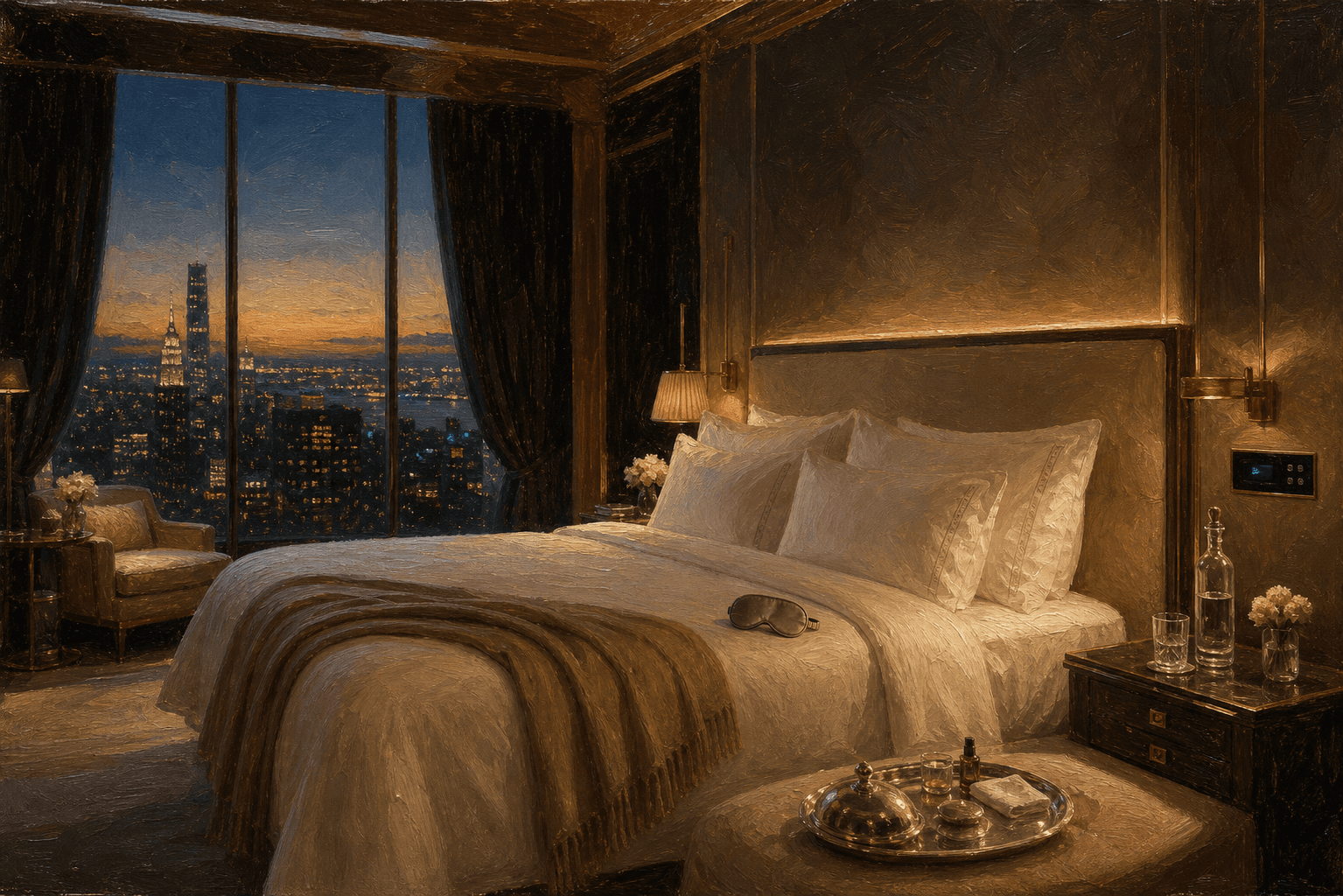
There are indulgences you stay awake for: champagne, auctions, midnight room service, a city glittering below the glass.
And then there is the luxury of paying a fortune to disappear.
The expensive nap is a strange masterpiece of modern wealth because it reverses the usual logic of display. No one sees you enjoy it. No one applauds the pillow. The body goes offline. The buyer becomes, for a few hours, unavailable even to vanity.
And yet the market has found a way to gild the unconscious.
Sleep is no longer merely what happens after the party. It is the party now, only darker, cooler, quieter, and staffed by people who would like to know your preferred pillow firmness before you surrender consciousness.
The $10,000 Bedtime
The cleanest specimen is the Hästens Ultimate Sleep Suite at Lotte New York Palace, reported by Forbes in 2019 as a $10,000-a-night sleep experience built around a Hästens mattress said to retail for $200,000.
The suite did not simply hand guests a key and hope for REM. It offered a Sleep Curator, pillow and temperature preferences, nutritional recommendations, teas, scents, sleepwear, slippers, blackout conditions, humidification, and the sort of soft-touch preparation usually reserved for diplomats, racehorses, and very sensitive orchids.
The bed itself was not a casual slab. Hästens describes its Vividus as a craft object that takes 45 unhurried days to complete, with nine bed artisans involved in the order. This is a fact that sounds less like mattress production and more like succession planning.
One does not sleep on a Vividus. One is received by it.
The Price Per Minute
Now the accounting.
If a $10,000 night buys eight clean hours of sleep, the unconscious comes to $1,250 per hour.
That is $20.83 per minute.
A classic 20-minute power nap becomes about $416.
A full 90-minute sleep cycle is $1,875.
Of course, this is generous accounting. It assumes you actually sleep for eight hours, which is optimistic for anyone who has ever paid too much for a hotel room and then spent the first 40 minutes lying awake, mentally inspecting the invoice.
Sleep Tourism Learns to Speak Performance
The Lotte suite now reads less like an oddity than a prophecy. Hotels have discovered that sleep can be upgraded into a full itinerary: smart mattresses, circadian lighting, blackout controls, soundscapes, tea, breathwork, cold exposure, warm exposure, sleep masks, sleep patches, and, inevitably, data.
Equinox Hotels offers a Sleep Lab room in New York that includes Eight Sleep adaptive mattress technology, personalized sleep and wake automation, circadian color meditation, soundscapes, AM and PM rituals, a sleep kit, and a sleep assessment. Its separate Art + Science of Sleep package lists a two-night stay, cryotherapy, Wave Table sessions, hot and cold plunges, and sleep-supporting turndown amenities, with the two-night stay starting at $1,850.
This is no longer a bed.
This is a board meeting for your parasympathetic nervous system.
The old hotel luxury was thread count. The new hotel luxury is a room that behaves like it has read a neuroscience paper and has concerns about your cortisol.
Why the Rich Now Buy Disappearance
Sleep is unusually elegant as a luxury product because it cannot be performed while it is happening.
You can photograph the bed beforehand. You can discuss the mattress. You can mention the sleep curator with the humble dread of someone who knows they have become difficult in a new way. But the actual luxury occurs after the ego leaves the premises.
That is what makes it seductive.
The wealthiest life is often sold as acceleration: faster car, faster jet, faster access, faster answer. But sleep sells the opposite. It is paid slowness. Sanctioned absence. A private room where the world is instructed to stop touching you.
At the high end, rest becomes not laziness but sovereignty.
The Great Recharge
This is not only a niche obsession of people who can afford mattresses with biographies. Hilton's 2024 trends work found that travelers across generations were prioritizing rest and recharge, and that sleep had become a more explicit part of how guests define a successful trip.
That matters because hospitality follows anxiety. If travelers worry about missing out, hotels sell access. If travelers worry about burnout, hotels sell recovery. If travelers worry that the modern world has turned their nervous systems into badly managed inboxes, hotels sell darkness, cool air, and someone else's confidence about pillow density.
The luxury hotel room has become a repair fantasy.
Not home, exactly. Better than home. Home contains laundry, Wi-Fi guilt, the drawer full of batteries, and the peculiar psychological violence of your own unfinished tasks. The sleep suite contains none of these things. It contains a tray, a mask, a button, and the implication that rest is finally being managed by professionals.
The Absurdity Is the Point
Could most people sleep better by doing ordinary things?
Yes.
Cool room. Dark room. Less alcohol. Less late caffeine. Fewer glowing rectangles interrogating the soul at 11:47 p.m. A consistent wake time. The boring, sturdy rules that never photograph well.
But Quantified Indulgence is not about the cheapest path to the effect. It is about the moment a basic human need is wrapped in enough ritual, technology, craft, and price to become symbolic.
The $10,000 night is absurd because the body still does the same humble thing it does everywhere else. It powers down. It repairs. It drifts. It becomes animal, helpless, magnificent, unaware of the thread count.
The Final Yawn
The most expensive nap in the world is not really about sleep.
It is about permission.
Permission to stop optimizing in order to optimize. Permission to spend money on absence. Permission to let other people construct the conditions under which your body can finally admit it is tired.
Luxury as darkness.
Recovery as room service.
Status measured in dollars per minute unconscious.
The wealthy once bought louder pleasures. Now the sharper indulgence may be silence, temperature, stillness, and a mattress so expensive it makes the act of sleeping feel like a limited-edition performance.
A fortune spent to vanish under white sheets, wake up, and call it wellness.
Sources
This essay draws on reporting and hotel materials about luxury sleep tourism, the Lotte New York Palace Hästens Ultimate Sleep Suite, Hästens Vividus, Equinox Hotels sleep programs, and Hilton's travel trends research.