There are luxuries that endure: diamonds, villas, cars, watches, archives of wine asleep in private cellars.
And then there is the melon.
In 2019, a pair of Yubari King melons sold at auction in Japan for 5 million yen, roughly $45,500 at the time. Not a painting. Not a watch. Not a numbered handbag in crocodile. Two melons.
They did not contain platinum seeds. They were not carved by monks. They did not arrive with a deed to a summer house. They were simply fruit: round, netted, fragrant, temporary, and perfect enough for someone to convert a small car into breakfast.
This is the first law of quantified indulgence: when money becomes bored with permanence, it begins purchasing disappearance.
The Price Per Bite
Let us do the obscene arithmetic.
A large melon might yield 12 elegant slices if cut with confidence and restraint. Two melons: 24 slices. At $45,500 for the pair, that places each slice somewhere near $1,895 before tax, shipping, ceremony, and the psychological cost of chewing.
Assume six bites per slice. That is roughly $315 per bite.
More if you are nervous.
The number is absurd, which is precisely why it works. Luxury stops being rational long before it becomes interesting. The $45,000 melon is not competing with other fruit. It is competing with the story of being able to spend $45,000 on something that will collapse into juice.
Fruit as Social Architecture
In Japan, luxury fruit carries a meaning that outsiders often misread. It is not only dessert. It is gift, apology, business gesture, seasonal marker, and aesthetic object. A perfect melon in a box is not saying "please enjoy snack." It is saying: I have selected a symbol of care so precise that eating it almost feels like a breach of protocol.
The best luxury fruit shops understand this completely. Fruit is arranged under glass like jewelry. Pears sit in foam cradles. Grapes are inspected with the seriousness of emeralds. Melons wear stems like aristocratic signatures.
This is not abundance. It is curation.
Anyone can buy a crate of fruit. The wealthy buy one piece that looks as if nature was forced through finishing school.
The Tyranny of Perfection
Luxury melon is built on intolerance. The shape must be balanced. The netting must be even. The aroma must bloom at precisely the right moment. The stem must remain theatrical. The flesh must carry enough sweetness to justify the silence around it.
Crown melon growers in Shizuoka are famous for a one-plant, one-fruit method, pruning away rivals so a single melon receives the full ambition of the vine. It is agricultural favoritism elevated to doctrine.
There is something deeply aristocratic about that. All resources diverted to one heir. The others sacrificed so the chosen one may become fragrant.
A supermarket melon is food. A luxury melon is a succession plan.
The Gift That Cannot Be Kept
The true genius of luxury fruit is that it refuses storage. A watch can be inherited. A handbag can be archived. A painting can acquire provenance. But a melon demands the courage of waste. It ripens. It softens. It insists.
To receive one is to enter a countdown.
That countdown is part of the status. The gift is expensive because it must be honored immediately. It reorganizes the room around its own decay. People gather. A knife appears. Someone says, too softly, "Should we?"
Yes.
You should. That is the entire point.
Why the Rich Love Fragility
Wealth often pretends to love durability: marble, bronze, leather, stone. But the highest forms of indulgence frequently move in the opposite direction. Caviar collapses. Champagne evaporates. Truffles fade. Flowers die. A private jet flight is over the moment it lands.
Fragility proves that the buyer did not need the object to last.
That is the quiet brutality of edible luxury. It says: I can afford beauty with no resale value.
The $45,000 melon is not wealth displayed. It is wealth metabolized.
The Poolside Calculation
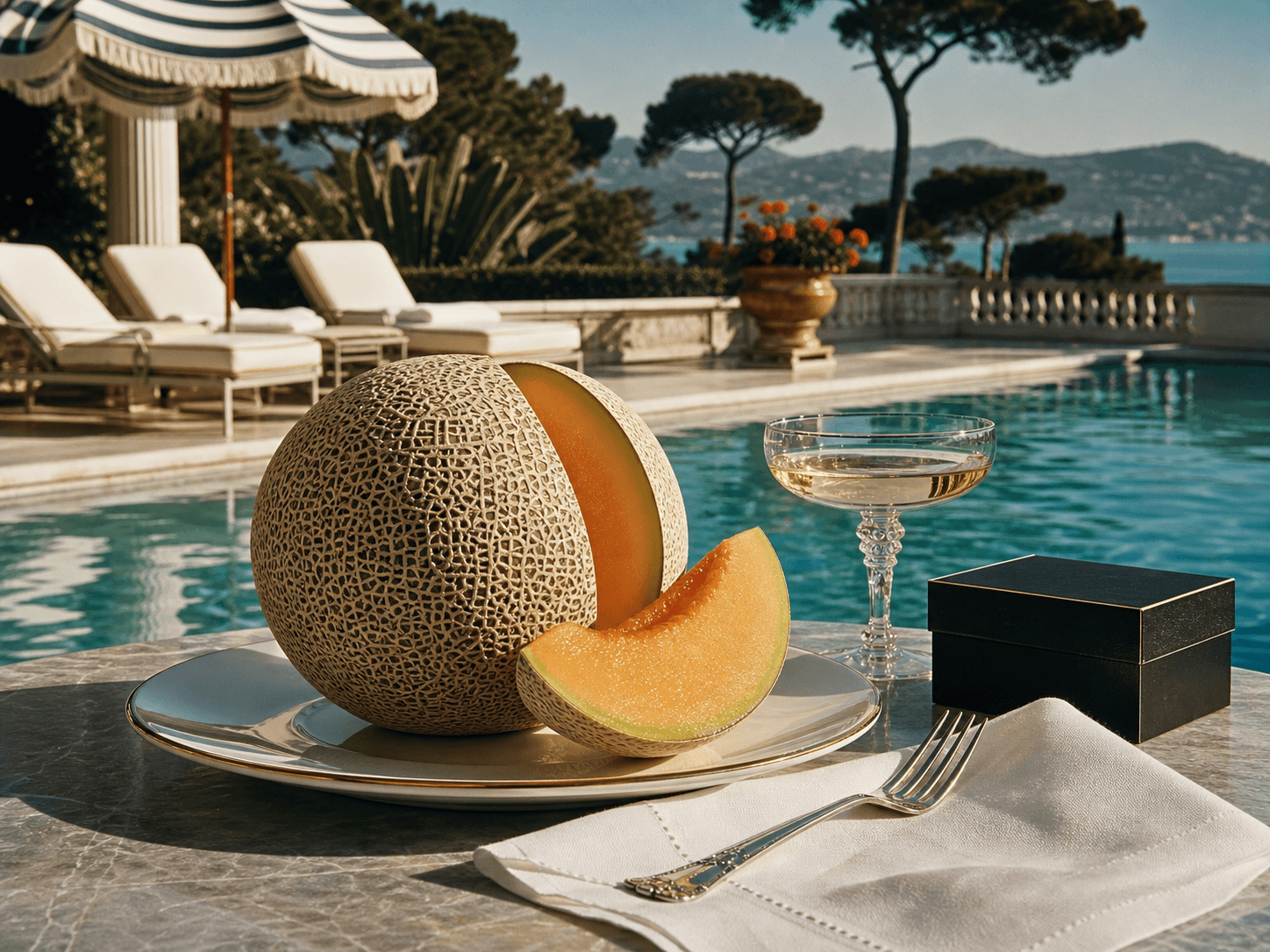
Imagine it served properly: white porcelain, linen napkin, silver fork, sun on the water, a terrace where nobody asks what anything costs because everyone already knows the question is vulgar.
A slice arrives chilled. Orange flesh, floral scent, a sweetness so clean it feels engineered by manners. Someone takes a bite. Closes their eyes. Nods.
And then what?
Nothing. That is the scandal. There is no climax large enough for the price. No bite can carry $315 of revelation. The tongue is not built for that kind of accounting.
So the pleasure moves elsewhere: to the table, the story, the absurdity, the fact that everyone present knows they are participating in a small, edible opera about money.
The Final Slice
This is what makes the melon perfect for Quantified Indulgence. It compresses the entire philosophy of luxury into a fruit bowl.
Price without permanence.
Agriculture as theater.
Sweetness measured in status per bite.
Most luxury objects ask to be preserved. The melon asks to be eaten before it becomes ordinary.
That is its cruelty. That is its charm.
A fortune, sliced cold, served beside the pool, gone by afternoon.
Sources
This essay draws on reporting about the 2019 Yubari King melon auction, Japan's luxury fruit gift culture, and Shizuoka Crown Melon growing methods.


