From the Editors at Highest Fade
I Made Eye Contact With the Sommelier and Pretended to Understand
A cautionary account of tannins, nodding, and the terrible social consequences of saying "interesting" near a decanter.
The trouble began when I nodded.
Not a casual nod. Not the small, polite downward motion one uses for elevators, doormen, or men holding doors with too much spiritual intensity. This was a grave nod. A professional nod. A nod that suggested I had encountered the vintage before and found it, if not emotional, at least structurally persuasive.
I had not encountered the vintage.
I had encountered the wine list, which was seventeen pages long and bound in something that had once been alive.
The sommelier stood beside the table in a dark suit and a silence so complete it seemed to have been decanted. He asked what I liked to drink. A normal man would have said, "Red." A wise man would have said, "Something medium-bodied." A coward, perhaps the happiest man in the restaurant, would have pointed to the second-cheapest bottle and accepted his fate.
I made eye contact.
This was my first mistake.
Eye contact with a sommelier is not social. It is contractual. It tells the room: I am entering the conversation as a person with views.
I did have views.
They were just largely unsupported.
The Wine List
The wine list was delivered with both hands, which should have warned me.
Menus are handed. Wine lists are entrusted. This one landed on the table with the quiet mass of a diplomatic archive. I opened it and immediately understood that civilization had gone too far.
There were regions. Sub-regions. Producers. Years. Words with accents. Words with hyphens. Words that appeared to contain weather systems. The prices moved with a confidence I found upsetting.
I scanned the page using the method many men use in wine situations: locate one familiar word, build a temporary identity around it, and hope no one asks about soil.
Pinot.
Thank God.
I knew Pinot. I knew it was red. I knew, crucially, that people in a movie had been emotional about it. And I knew what I was talking about. I've seen Sideways, for crying out loud.
This is not nothing.
It is not something, exactly. But it is not nothing.
The Question
The sommelier returned.
"What are you in the mood for tonight?"
A gentle question, if asked by a friend.
A loaded weapon, if asked by a man wearing a tastevin.
I looked down at the wine list and then back up at him. The table went quiet in that particular way tables go quiet when everyone senses a person may attempt expertise.
"Something with a little... tension," I said.
No one moved.
Tension.
Why had I said tension? I do not know. It arrived from a part of me that wears scarves indoors and uses the word "interesting" to describe chairs that injure guests.
The sommelier did not laugh.
This was unhelpful.
He nodded, which escalated the situation from embarrassing to official.
The First Pour
He suggested a bottle from a producer whose name contained three consonants in a row and possibly a moral philosophy.
"There's nice acidity," he said. "A little lift. Very mineral."
Mineral.
I knew this word. More importantly, I knew not to ask what it meant.
The bottle arrived. The foil was cut. The cork was removed with the small, efficient movements of a person who has never once opened a drawer too aggressively. He poured a taste into my glass.
This is the cruelest ritual in dining.
A tiny amount of wine is placed before you, and the entire table pretends the next five seconds are about quality control rather than theater. In theory, you are checking that the wine is sound. In practice, you are being asked to perform adulthood in front of witnesses.
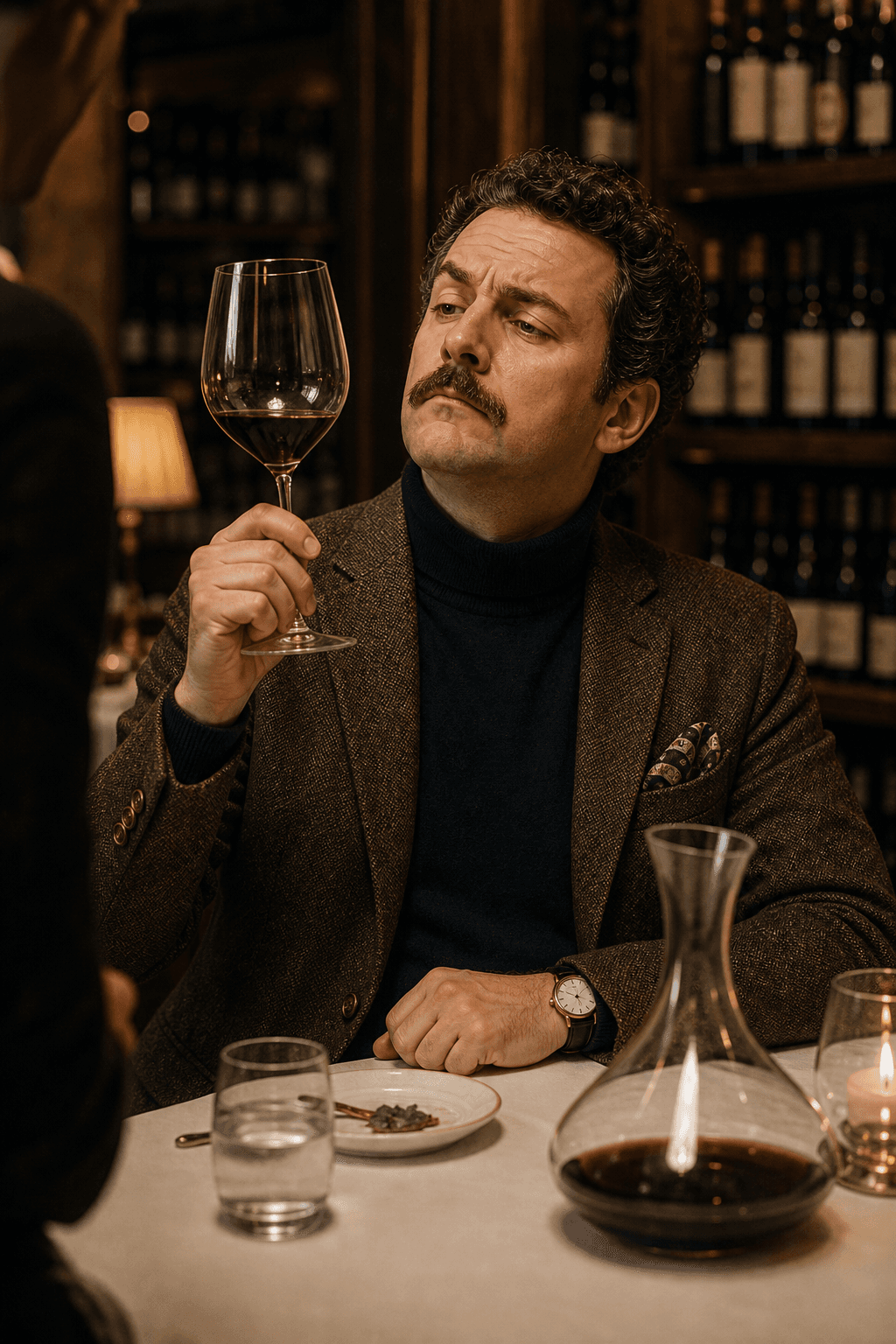
I swirled.
Too much.
A man should swirl with modesty. I swirled like I was trying to open a portal.
I smelled the glass.
It smelled like wine.
This was both true and unusable.
The Comment
I took a sip.
The wine was good. I knew this because my face immediately tried to look thoughtful. I held the glass by the stem, which I had remembered at the last second, and looked slightly to the left, where people apparently store perception.
"Yes," I said.
This would have been enough.
This would have ended the ritual with dignity intact. The sommelier would have poured. The table would have resumed. I would have lived a normal life.
Instead, I added:
"There's definitely some restraint here."
I am telling you now, as a warning to future generations: never say restraint unless you are prepared to defend it.
The sommelier's eyes changed.
Not dramatically. Sommeliers do not react dramatically. They alter temperature. But something in his gaze sharpened, and I realized I had left the safety of approval and wandered into analysis.
"Yes," he said. "Exactly."
Exactly.
I had been certified by a stranger.
Catastrophe.
The Table Changes
Once the wine was poured, everyone treated me differently.
Not better, exactly. Worse. With expectation.
Someone asked what I thought of it with the entrée.
I had been eating chicken.
I looked at the glass, then at the plate, then back at the glass, as if triangulating a landing.
"It holds up," I said.
Holds up.
To what? Poultry? The evening? Western civilization? I had no idea.
But the phrase worked. People nodded. The wine held up. I held up. The chicken, if anything, looked relieved.
Then someone asked about the finish.
I took another sip and waited for the wine to finish.
It did not announce itself.
"It's clean," I said.
Another word I had found floating in the wreckage.
The Second Bottle
The true disaster came when the table finished the bottle.
A person who had not been paying attention said, "Should we let him choose another?"
Him.
I had become him.
The sommelier returned, perhaps sensing blood in the water, though I do not know if sommeliers use that phrase. Probably not. Probably they say salinity.
"Shall we stay in the same lane?" he asked.
Same lane.
I had not known there was a lane. I had thought we were in a restaurant.
"Maybe adjacent," I said.
Adjacent.
I watched the word leave my body and join the evening permanently.
The sommelier smiled. Not broadly. Just enough to let me know the game had become more interesting for him and more legally complex for me.
The Fraudulence
This is the terrible thing about pretending to understand wine: some of the pretending becomes real.
You begin by surviving. You say "bright" because it sounds safe. You say "earthy" because the wine is red and you have encountered dirt. You say "old world" because the bottle looks like it has a pension.
Then, suddenly, you notice something. A sourness. A softness. A scent like cherries if cherries had attended graduate school. You are not an expert, but you are no longer entirely lying.
This is dangerous. Partial knowledge is the most socially explosive knowledge. It gives a man courage before it gives him accuracy.
By dessert, I had opinions.
I disliked this about myself immediately.
The Check
When the check came, the wine line had numbers beside it that suggested my vocabulary had not been free.
I looked at the total and became briefly sober in all available meanings.
Someone said the wine had been worth it.
I nodded with restraint.
I was learning.
Outside, the air was cooler. The restaurant glowed behind us. I had survived the sommelier. I had chosen wine. I had used the word adjacent in public and remained technically employable.
Then someone asked if I could recommend something for their dinner party next week.
I looked into the middle distance.
A lesser man would have confessed.
I said, "What are you serving?"
And that, regrettably, is how expertise begins.
Minor Theatrics
A collection of civilized misadventures.
From the editors of Highest Fade