From the Editors at Highest Fade
I Became Competitive About Relaxing at the Villa
A cautionary account of linen, sparkling water, and the terrible pressure to appear restored by noon.
The villa was designed to defeat anxiety.
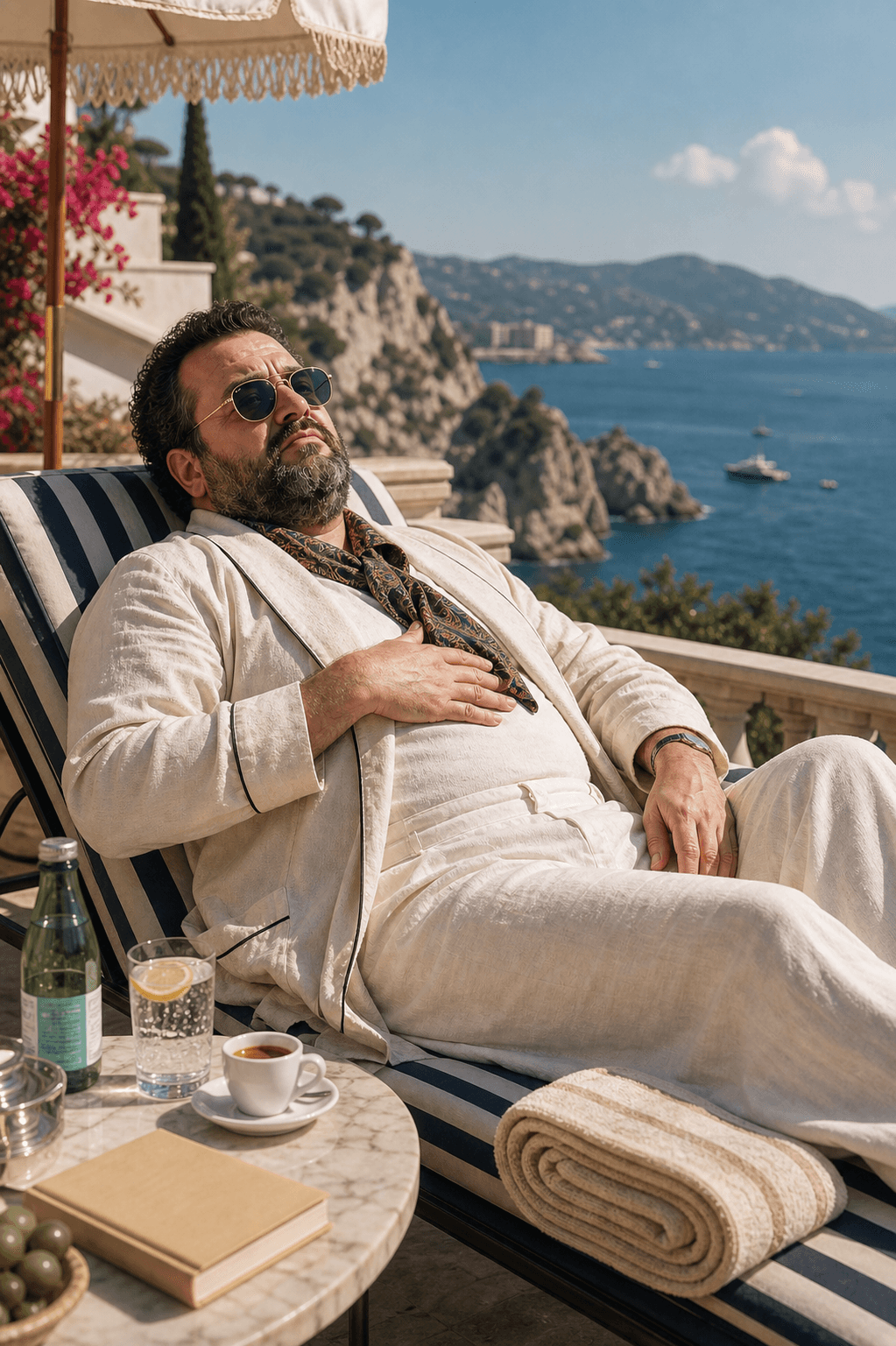
This was clear from the moment I arrived. White walls. Stone steps. A terrace facing the sea with the quiet arrogance of inherited money. Bougainvillea doing frankly too well. A pool so blue it seemed less like water than a legal argument for generational wealth.
Everything about the place said, "Release."
Unfortunately, I heard, "Perform."
I had been invited for four days of rest by people who used phrases like "just come and do nothing" as if nothing were a simple activity one could enter without credentials. I nodded when they said it. I packed linen. I brought a book with deckled edges. I told myself I was ready to become loose, sunlit, and impossible to reach.
But some men cannot relax. They can only compete in the category of relaxation, privately, against opponents who do not know the tournament has begun.
The Arrival
The others entered the villa like normal people. They said things such as "wow" and "this is gorgeous" and "I might nap later." They placed bags in rooms. Someone removed their shoes. Someone stood by the railing and looked at the water without trying to turn it into a personal brand.
I, meanwhile, immediately began assessing the emotional difficulty of the view.
It was almost offensively beautiful. The sea moved below us with the indifference of a billionaire ignoring a text. Small boats marked the horizon. The air smelled like salt, rosemary, and the kind of sunscreen that makes you wonder whether your childhood was underfunded.
"You have to relax here," someone said.
I laughed, too quickly.
"Oh, I will," I said.
It came out like a threat.
The Outfit
I had packed for ease with the intensity of a military operation.
Three linen shirts, all slightly different shades of expensive fatigue. Cream trousers. Sandals that suggested I understood the Mediterranean without needing to speak. A robe. A bathing suit in a color best described as "boat-adjacent." Sunglasses heavy enough to imply discretion.
These were not clothes. They were evidence.
Evidence that I knew how to be casual at altitude. Evidence that I could be photographed accidentally and look like someone who had forgiven several currencies. Evidence that I understood the difference between leisure and abandonment.
At 10:17 the next morning, I emerged onto the terrace in a linen shirt worn open over a white tee, a towel draped over one shoulder, and the facial expression of a man prepared to metabolize beauty at a high level.
Someone was already in the pool.
This irritated me.
Not because I wanted the pool. Because they had begun relaxing before the group had established standards.
The Lounger
There are many ways to sit on a lounger. Most of them are wrong.
Too flat and you look ill. Too upright and you look like you are waiting for a ferry. One leg bent suggests ease. Both legs bent suggests concern. Sunglasses on means privacy. Sunglasses off means you are available for conversation, which is not relaxation but community service.
I chose a position I believed communicated recovered but alert.
This lasted eleven seconds.
The cushion made a sound beneath me. My shirt wrinkled in a way that felt personal. The towel slid off my shoulder and landed in a small heap by my hip, where it looked less like a towel than a collapsed argument. I adjusted. Then adjusted again. Then attempted to adjust in a manner that looked as though adjustment had never occurred to me.
Across the terrace, a friend was reading with one arm over their face.
I hated how natural it looked.
The First Beverage
The villa had sparkling water in glass bottles, which is how a house tells you it has opinions.
I poured myself a glass with too much care. Three ice cubes. A slice of lemon. Not because I wanted lemon, exactly, but because plain water felt insufficiently edited. I lifted the glass and looked toward the coastline, hoping to be seen by no one and appreciated by everyone.
Someone said, "You look very relaxed."
This was disastrous.
Praise creates pressure. If you are told you look relaxed, you must either remain relaxed or become the kind of person who has betrayed a visual promise. My shoulders rose slightly. I lowered them with force. Then I wondered if forced shoulder-lowering was visible from the pool.
"I am," I said.
The glass sweated in my hand.
So did I.
The Nap Attempt
By early afternoon, the villa entered nap weather.
Nap weather is different from ordinary tiredness. It is environmental permission. Curtains move. Lunch recedes. The body receives a memo from the island: please stop trying to be impressive for twenty-three minutes.
I announced that I might rest.
This was my first mistake. A true nap is discovered, not declared. The moment you announce one, it becomes a deliverable.
I returned to my room, closed the shutters, lay on top of the bed in what I hoped was a European arrangement, and waited to become a man with access to softness.
Instead, my mind became a meeting.
Was I breathing correctly? Had I chosen the wrong room? Did the others think I was too committed to the nap? Not committed enough? Was anyone else napping better? Could napping be overheard? Would I emerge with pillow marks, and if so, could they be styled as evidence of depth?
After forty minutes, I got up unrested and furious with the concept of restoration.
The Book
The book was a mistake.
Not because it was bad. Because it was good in a way that made me want credit for owning it. I had selected it carefully: slim, serious, not showy, the kind of book that says, "I came here to rest, but not at the expense of my interiority."
I brought it to the terrace and placed it beside me with the cover facing up at an angle only a coward would call accidental.
Then I read the same paragraph nine times.
The words would not enter. They stood at the gate of my attention and refused to show identification. I kept looking over the top of the page to see whether anyone had noticed the book, which made reading difficult in the traditional sense.
"How is it?" someone asked.
Finally.
"Quiet," I said, because I had read eight sentences and owned a shirt.
The Competition
By day two, I understood the villa had become a leaderboard.
No one else knew this, which gave me an advantage and made my victory more complex.
There were categories. Best breakfast ease. Most convincing barefoot walk to the pool. Cleanest transition from conversation to gazing at the horizon. Least needy relationship with a phone. Most natural second espresso. Best towel placement. Strongest evidence of having healed from something without mentioning what.
I was competitive in several divisions.
Unfortunately, my rivals were relaxed, which made them dangerous. They did not care about towel placement. They placed towels and moved on. They did not check whether their linen had achieved the correct collapse. Their linen simply collapsed. They did not ask the sea to validate them. They looked at it and then ate chips.
I began to resent their amateurism.
The Breakthrough
The breakthrough came on the third evening, after I spilled a small amount of olive oil on my trousers.
At first, I experienced this as a collapse of the project. Cream linen does not forgive. It remembers. The stain sat there on my thigh, golden and smug, ruining the line of a man who had spent forty-eight hours trying to appear like a relaxed person in an expensive novel.
I went very quiet.
Then someone laughed.
Not cruelly. Worse: accurately.
And something in me loosened. Not spiritually. Let's not become unbearable. But physically, a little. The stain had done what the sea, the villa, the robe, the lemon water, and the allegedly restorative nap had failed to do. It had made the performance impossible.
I stopped competing because the scoreboard had been stained.
For twenty minutes, I was almost pleasant.
The Problem with Wanting It
Here is the humiliating truth: I loved the villa.
I loved the terrace. I loved the view. I loved the glass bottles and the heavy towels and the little bowls of olives that appeared as if summoned by a more competent civilization. I loved the way the afternoon made ambition seem rude. I loved the fantasy that a better setting might create a better self.
That is the trap. Affluence is absurd, and also very persuasive. You can mock the villa all you like, but if someone offers you the good room with the sea view, you will not sleep in the laundry room as an act of ideological purity.
You will take the room.
You will open the shutters.
You will stand there in your wrinkled linen, pretending the beauty has not immediately compromised your politics.
The Departure
On the final morning, I woke early and went to the terrace alone.
The cushions were still damp with night air. The sea had resumed its impossible behavior. A single espresso waited beside me because I had made it myself, badly, but in a small cup, which helped.
I sat down without arranging myself.
This was either growth or exhaustion. I have chosen to call it growth.
For a moment, no one saw me. No one assessed my posture. No one admired my towel. No one knew whether I was winning.
I looked at the water.
It did nothing for my character.
But it was beautiful.
Which, annoyingly, was enough.
I left the villa unrestored, lightly stained, and absolutely interested in returning.
Minor Theatrics
A collection of civilized misadventures.
From the editors of Highest Fade