From the Editors at Highest Fade
I Asked for No Cilantro and Became the Problem
A small herb, a reasonable request, and the sudden collapse of my public character.
I did not want to be difficult.
That is important to understand. I entered the restaurant as a normal man, or as close to one as the lunch hour allows. I was wearing a clean shirt. I knew what I wanted. I had rehearsed nothing.
Then the cashier asked, "Any modifications?"
A trapdoor in daylight.
There are people who move through life making modifications without injury. Sauce on the side. No onions. Extra lime. They say these things with the bland authority of regional managers. Their requests land softly in the world.
Mine do not.
I cleared my throat.
"No cilantro, please."
The room changed.
Not dramatically. No one gasped. A chair did not fall over. Somewhere, a blender continued its important work. But a small moral weather system formed above the counter.
The cashier looked at the screen.
"No cilantro?"
There it was. Repeated back to me. Entered into the record.
Suddenly I was not ordering lunch. I was testifying.
The Herb Itself
I have nothing against cilantro as a concept. Let that be stated clearly. I support herbs. I believe in green things. I have stood beside parsley in moments of uncertainty and found it harmless, even helpful.
Cilantro, however, has always treated me like it knows something.
It arrives too confidently. It scatters itself over food with the air of a guest who brought a guitar. It does not blend. It interrupts. One leaf and suddenly the entire meal tastes like a raincoat in a garden center.
I understand this is genetic for some people. I understand there are receptor explanations. I understand science has entered the chat wearing a lab coat and carrying empathy.
But standing at that counter, I did not feel like a man with a harmless sensory preference.
I felt like an enemy of freshness.
The Line Behind Me
The problem with making a food request is that it creates audience.
Behind me stood three people, each more effortless than the last. A woman in sunglasses indoors, which somehow worked. A man in a soft black T-shirt who appeared to understand mezcal. A couple sharing a menu with the relaxed intimacy of people who would never say "no cilantro" in public because their bodies simply accept life.
I could feel them hearing me.
No cilantro.
Such a small phrase. So much evidence.
Evidence of fragility. Of control. Of a childhood probably involving beige foods and emotional weather. Evidence that I am not a man who lets the chef decide. Evidence that if handed a beautiful thing, I might ask whether it comes in a quieter version.
The cashier tapped the screen.
"Anything else?"
This question was cruel because there was something else.
I also wanted no raw onion.
I could not say it.
A man gets one modification before society begins assembling a profile.
"No, that's perfect," I said.
It was not perfect. It had onion coming.
The Waiting Area
After ordering, I moved to the side with the posture of someone who had just survived customs.
The waiting area was narrow and socially overlit. This is where people become aware of their hands. I checked my phone, but only to appear employed by reality. Nothing on it mattered. I opened my email and stared at a shipping notification with the intensity of a priest reading omens.
Behind the counter, someone called to the kitchen.
"One no cilantro."
One.
I had become a unit.
Not a gentleman. Not sir. Not the guy in the clean shirt. One no cilantro. A type. A cautionary order. A small administrative burden with legs.
I wanted to explain myself to the kitchen.
"I'm not against flavor," I would say. "I have traveled. I have eaten things from small bowls in cities where I did not speak the language. I own smoked paprika. I am not who this ticket makes me seem."
But no one had asked.
That is the tragedy of reputation. It forms without your rebuttal.
The Arrival
My name was called with no warmth.
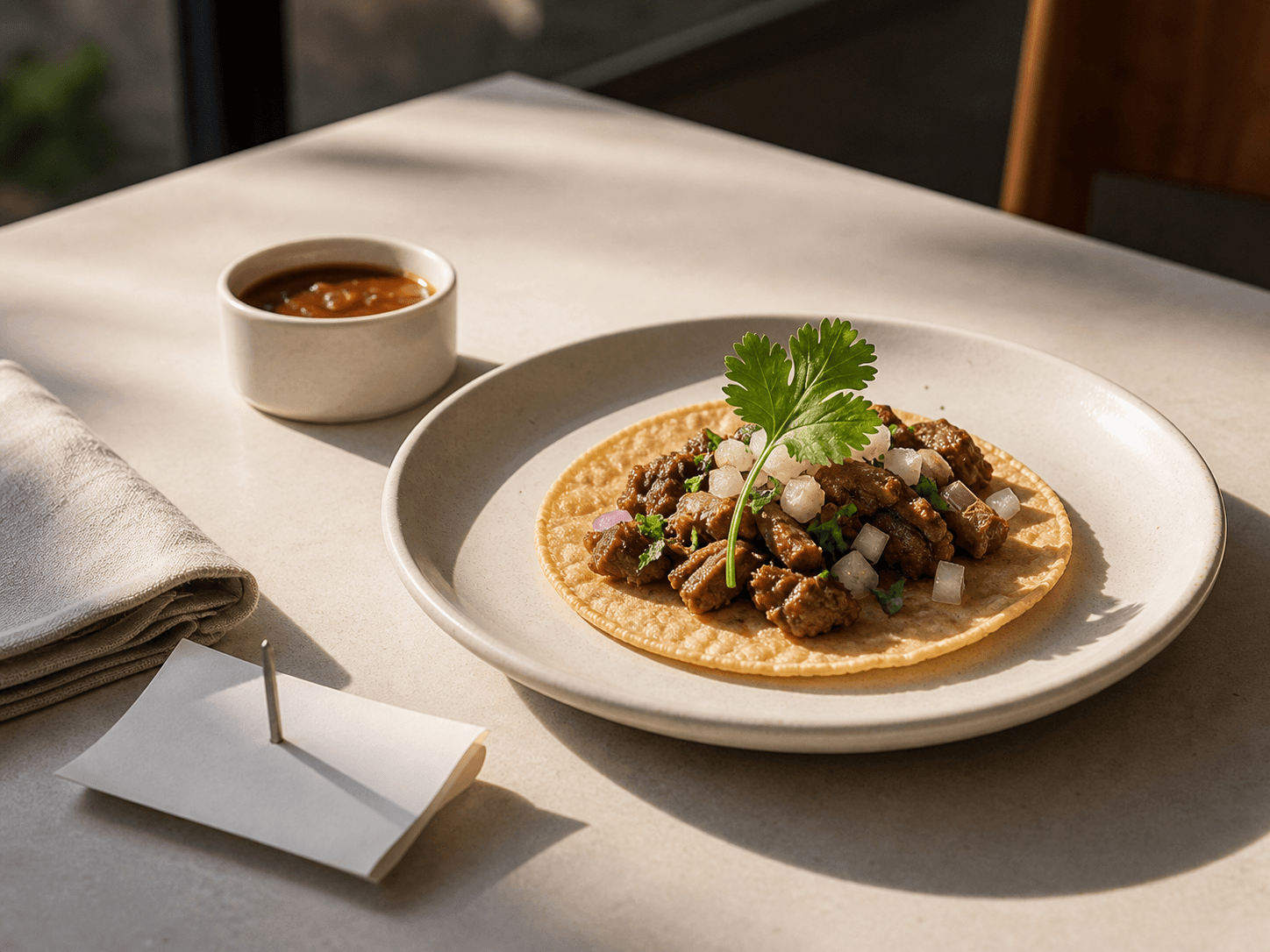
I stepped forward. The plate was placed on the counter. Two tacos, arranged beautifully. Lime wedge. Salsa. Onion, of course, in proud white flecks. And there, resting on the left taco like a legal document:
Cilantro.
Not a lot.
That was the problem.
If it had been covered in cilantro, I could have acted. A mound is evidence. A visible breach. But this was a sprig. One deliberate green flourish. Ambiguous enough to trap me between principle and dignity.
I stared at it.
The cashier saw me staring.
"Everything okay?"
There are moments in life when the self divides.
One part of me wanted to say, gently, "Actually, I asked for no cilantro." That part had boundaries. That part had read things about self-advocacy. That part probably returned library books on time.
The other part of me had already calculated the social cost of being corrected as a garnish-based dissident.
"Perfect," I said.
Reader, I took the plate.
The Table
At the table, I attempted removal.
Not openly. I am not a farmer. I did not want to be seen harvesting my lunch. So I used the side of my fork with the stealth of a man disposing of evidence in a drawing room.
The sprig clung.
Cilantro has no weight until you are trying to remove it with dignity.
It caught in the crema. It dragged salsa. It separated into smaller units, each now more difficult to extract. What began as one herb became a diaspora.
Across from me, a man ate his taco without inspection.
I hated him.
Not personally. Philosophically. He belonged to the world in a way I did not. He received food and trusted it. He chewed without conducting a post-arrival audit. His nervous system had never opened a claims department over garnish.
I took a bite.
It tasted mostly fine.
This was devastating.
The Larger Question
Why did I care?
Not about the cilantro. That was between me and biology. Why did I care about being seen caring?
There is a certain kind of modern shame attached to preference. We are supposed to be flexible, global, chill, eager, unfussy, alive to complexity. To refuse a herb feels, somehow, like refusing culture.
But taste is not morality. A palate is not a passport. You are allowed to dislike one green thing without becoming a provincial uncle with opinions about foreign films.
I know this.
I believe this.
And yet I still ate around the cilantro like a man negotiating with a tiny flag.
The Aftermath
When I finished, the plate looked guilty.
Small green fragments remained at the edge, arranged not randomly but narratively. A record of avoidance. If a detective had seen it, he would have removed his sunglasses.
I considered hiding the evidence under the napkin. Too much. I considered eating the remaining leaves in one act of self-overcoming. Dangerous. I considered leaving proudly, as a man with preferences.
I chose a fourth path:
I stacked the plate with the moral ambiguity facing down.
On the way out, the cashier said, "Have a good one."
I said, "You too," with more gratitude than the exchange required.
Outside, the air smelled faintly of exhaust and someone else's lunch. I walked home thinking about courage. Not the big kind. Not war, not love, not confession.
The small kind.
The kind required to say, politely, "Actually."
I am not there yet.
But someday, when the moment comes, when the plate arrives wrong and the room holds its breath, I hope to stand calmly in my life and speak the truth.
No cilantro.
Please.
And maybe, if the light is good and I have slept, no raw onion either.
Minor Theatrics
A collection of civilized misadventures.
From the editors of Highest Fade