From the Editors at Highest Fade
The Host Said "Make Yourself at Home" and I Took It Literally
A cautionary study in slippers, boundaries, and the dangerous elasticity of hospitality.
I have always considered myself a respectful guest.
I bring wine. I arrive seven minutes late, which is what punctuality becomes after it learns empathy. I compliment lighting. I stand briefly in the entryway with the humble alertness of a man waiting to be told where shoes go.
I do not open drawers. I do not ask for the Wi-Fi unless the evening has clearly entered its administrative phase. I do not sit in the obviously expensive chair, even when it calls to me with lumbar promises.
So when Marissa, my host, smiled from the kitchen and said, "Make yourself at home," I understood, intellectually, that this was not an instruction.
It was a ritual phrase.
Like "we should catch up soon" or "no pressure" or "just wear whatever." A decorative sentence. A social throw pillow. Something placed in the room to soften the edges of power.
And yet something in me heard it differently.
Something old. Something tired. Something wearing socks with a serious opinion about overhead lighting.
"Thank you," I said.
Then I made myself at home.
The First Mistake Was Confidence
The apartment was immaculate in the way certain apartments appear less lived in than lightly supervised by a museum. The books were arranged by mood. The sofa was a shade of cream that suggested no one in the home had ever eaten salsa with ambition. There was a candle burning somewhere with a name like Winter Fig or Quiet Linen or Divorced Architect.
I stood in the living room holding my bottle of wine, waiting for someone to take it from me, because that is the first trial of adulthood: knowing whether a gift should be surrendered immediately or carried around like a ceremonial infant.
No one took it.
Marissa was stirring something in a pot. Her boyfriend, Julian, was adjusting music on a speaker with the gentle seriousness of a man choosing a soundtrack for an inheritance dispute. Two other guests were already there, leaning against the kitchen island with the slack elegance of people who knew where to put their hands.
I placed the wine on the counter.
Good. Normal. A strong opening.
Then I removed my shoes.
No one had asked me to remove my shoes.
There was no basket of slippers, no visible shoe colony by the door, no cultural cue, no small sign with whimsical lettering. I simply decided, based on the phrase "make yourself at home," that shoes were a barrier between me and the evening's deeper covenant.
My socks were navy. This matters because navy socks, in isolation, are fine. Navy socks in a stranger's living room, beneath tailored trousers, create the impression of either convalescence or a man who has just been through airport security.
Julian saw them first.
His eyes moved down, paused, and returned to my face with diplomatic restraint.
"Oh," he said. "You can keep your shoes on."
The word "can" did extraordinary damage.
It did not mean permission. It meant correction wearing linen. It meant: We are not that kind of home, and you have guessed wrong in front of everyone.
I looked at my loafers by the door. Too far. Publicly far. To retrieve them would be to stage a retreat. To remain shoeless would be to double down.
I chose ruin.
"I'm actually more comfortable this way," I said.
Which was untrue. I have never been less comfortable in my life.
The Sofa Incident
Once you are shoeless at a dinner party where shoes are still happening, the body begins searching for an identity. You cannot hover. Hovering in socks is unforgivable. You must sit, or help, or disappear.
I chose sitting.
Unfortunately, I chose the sofa.
Not just the sofa. The center cushion. The throne cushion. The place no guest should occupy before emotional weather has been established. A guest belongs at the edge of furniture until invited inward. Everyone knows this. Children know this. Nervous dogs know this. I, briefly intoxicated by hospitality language, forgot.
The sofa accepted me with terrifying softness.
I sank lower than expected. My knees rose. My socks became more visible. I had entered a posture that could only be described as uncle between jobs.
Across the room, one of the guests, a woman named Claire, glanced at me and then at the empty chair beside her. It was a small glance, but it contained a seating chart.
I attempted to recover by holding my wine glass with sophistication.
It was empty.
I had not been served wine yet. I was holding water in a stemmed glass and performing Bordeaux around it.
This is when Marissa called from the kitchen, "There are snacks on the table. Help yourself."
Help yourself.
Another trapdoor in silk.
I reached for an olive. One olive is modest. Two olives is appetite. Three olives is biography.
I took one.
It had a pit.
No one tells you how quickly a sophisticated evening becomes tactical once you are holding an olive pit in your mouth with no napkin and no visible disposal plan.
I looked for a small plate. There was none. I looked for a napkin. They were linen, folded into severe rectangles, clearly not yet emotionally available. I considered swallowing the pit. For perhaps two seconds, I believed this was maturity.
Then Claire said, "You can just put it on the little dish."
The little dish was directly in front of me.
It had been there the whole time, quietly judging my survival instincts.
The Thermostat Became Political
A lesser man might have stabilized there. Shoes off, sofa compromised, olive pit survived. Enough damage for one evening. But I had not yet exhausted the phrase.
Make yourself at home.
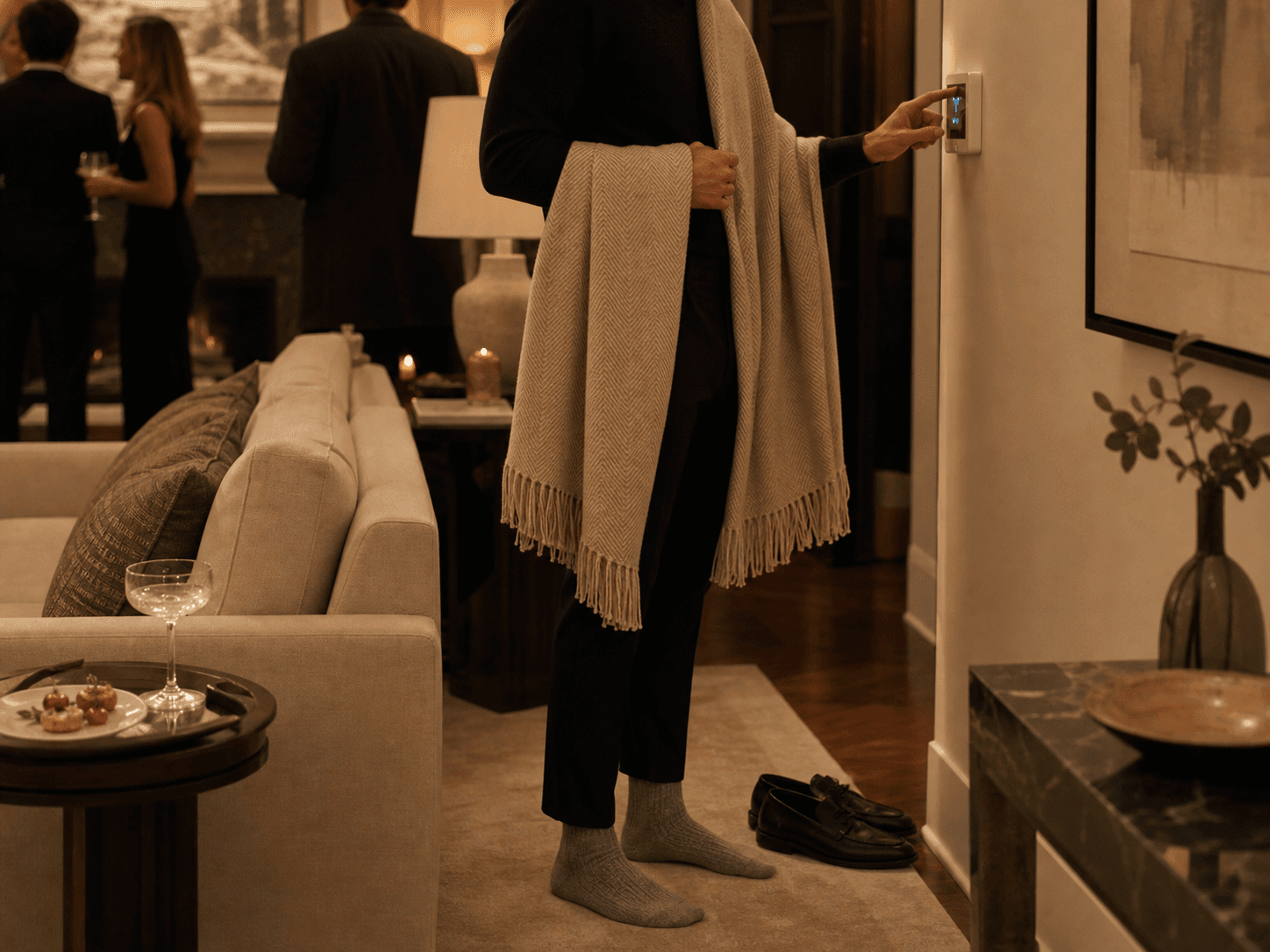
At home, I adjust temperature.
This thought arrived in my mind whole, like bad scripture.
The apartment was warm. Not dramatically warm. Not medically warm. Just the kind of warm that makes red wine feel accusatory. I was wearing a sport coat because I had wanted to seem like a person with evening opinions. Now the collar pressed against my neck with legal force.
I removed the sport coat.
Acceptable.
I folded it over my arm.
Fine.
I walked toward the thermostat.
Treason.
I did not touch it. Let the record show that I did not touch it. I merely approached, as one approaches art, with hands clasped behind my back and an expression of technical curiosity.
Julian saw me.
"Everything okay?" he asked.
There is no good answer to this question when you are six inches from another man's thermostat in socks.
"Just admiring the system," I said.
The room went quiet in a way rooms only go quiet when everyone has chosen, independently, not to help.
"It's a Nest," Julian said.
"Beautiful interface," I replied.
I had become a man no one had invited.
The Blanket Was Where I Lost Them
Dinner itself was lovely. Chicken with lemon. Potatoes with herbs. A salad that seemed to have been dressed by someone with a graduate degree in restraint.
I behaved well for nearly thirty minutes.
I asked questions. I laughed proportionally. I did not mention the thermostat. When the conversation turned to travel, I contributed one charming anecdote about missing a train in Vienna and left out the part where I cried near a vending machine.
Then, after dinner, we returned to the living room.
The sofa was waiting.
I avoided the center cushion this time, which I considered growth. I chose the far edge and sat with the careful geometry of a guest under review.
Someone opened a window. The room cooled. The candle flickered. A soft breeze moved through the apartment, carrying the scent of rain and coriander and whatever moral lesson had been building all night.
Beside me lay a throw blanket.
Folded. Textured. Suggestive.
At home, I use blankets.
I know. I know.
But it was right there, arranged diagonally over the sofa arm in the universal language of "I am for looking at, unless you are family or unwell." I understood this. I understood it as one understands a sign at a museum that says Do Not Touch. Clearly. Completely. Too late.
I placed it over my lap.
Not fully. Just enough.
A civilized drape.
Claire stopped speaking mid-sentence.
Marissa looked at the blanket, then at me, then at the blanket again, as if I had begun reading her diary aloud in a pleasing baritone.
"Are you cold?" she asked.
This was not concern. This was an audit.
"A little," I said.
A lie. I was thermally neutral. Spiritually aflame.
Julian closed the window.
The blanket remained on me, heavier now, transformed from textile into evidence.
I had done what no guest should do: I had created a problem that caused the host to adjust the room around my fiction.
The Bathroom Made It Worse
Later, needing a private moment to regroup, I asked for the bathroom.
Marissa pointed down the hall.
"First door on the left."
I went to the second door.
No reason. No excuse. The first door was plainly on the left. I simply lost faith in language.
The second door was a bedroom.
I saw a made bed. A chair with a sweater on it. Two books on a nightstand. The private evidence of lives not meant for guests. I closed the door quickly, but not quickly enough to avoid learning that Julian used a sleep mask.
This knowledge changed our relationship.
In the bathroom, I washed my hands for too long and stared at myself in the mirror.
"You are a guest," I whispered. "Not a tenant."
But even this correction arrived late. My hair had taken on the flatness of a man mid-apology. My socks had collected a small piece of lint from a rug that probably cost more than my first car. I was no longer attending dinner. I was surviving a character assessment administered by furniture.
The Departure
Leaving a home after you have over-inhabited it requires delicacy.
You cannot flee. Fleeing confirms guilt. You cannot linger. Lingering becomes tenancy. You must depart with a lightness that says: I was never truly here, and if I was, I respected the coasters.
At 10:43, I stood.
Too abruptly.
The blanket slid from my lap onto the floor.
I bent to pick it up. Marissa also bent. Our hands nearly touched over the fallen textile, which is the closest I have come to a Victorian scandal.
"I've got it," she said.
She did not mean the blanket.
I retrieved my shoes by the door. They looked different now. Smaller. Ashamed of me. I slipped them on without a shoehorn, which felt like a final moral failure.
"This was so lovely," I said.
"I'm so glad you felt comfortable," Marissa replied.
There are sentences that smile with all their teeth.
I nodded like a man receiving a sentence from a small court.
Outside, the night air was merciful and cold. I walked three blocks before realizing I was still carrying one of their linen napkins.
I had folded it into my coat pocket during dessert. Neatly. Instinctively. Like property was a suggestion.
I considered turning back.
I considered mailing it.
I considered starting over in another city under a simpler name.
Instead, I texted Marissa.
"I think I accidentally stole a napkin. So sorry."
Three dots appeared.
Vanished.
Appeared again.
Then came her reply.
"No worries. Make yourself at home."
I stared at the screen.
Cruel? Forgiving? Elegant? A trap resetting itself?
I may never know.
But I still have the napkin.
It lives in my top drawer now, folded with shame and a kind of tenderness.
Sometimes, when guests come over, I place it on the table.
Not because it matches.
Because it knows too much.
And because in my home, apparently, everyone is welcome to make one grave mistake.
Minor Theatrics
A collection of civilized misadventures.
From the editors of Highest Fade