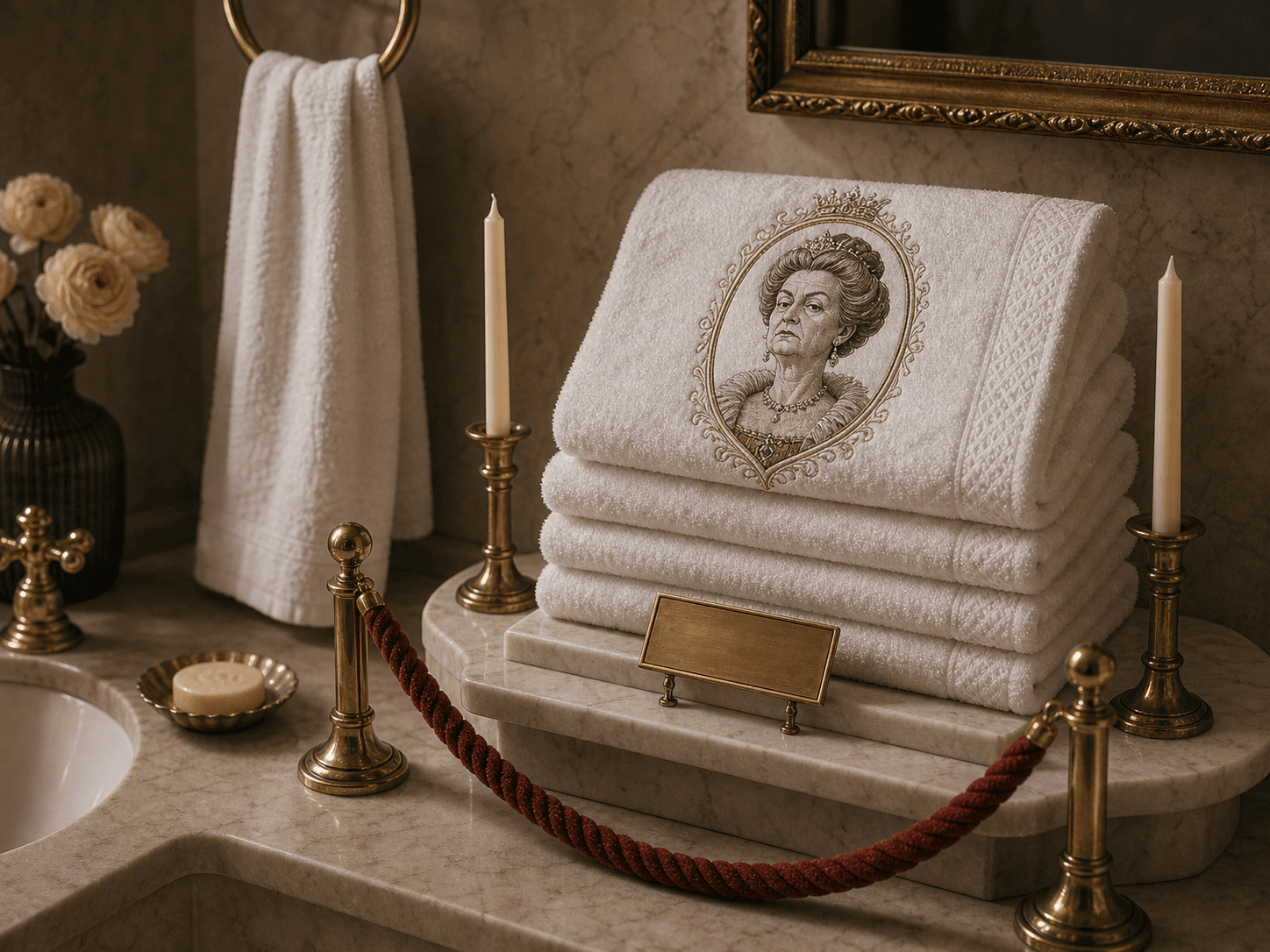
A guest towel is not a towel.
It is a moral exam folded into thirds.
You discover the guest towel alone, usually in a powder room small enough to make self-consciousness unavoidable.
The door closes. The party becomes a murmur beyond the wall. You wash your hands with the careful seriousness of someone trying not to splash a stranger's marble. Then you turn, innocent and damp, and see it.
The towel.
Not the towel you use. Obviously not. That would be vulgar. This towel has been folded with a degree of intention normally reserved for flags, sacred garments, and divorce papers. It sits in a stack beside the sink, pale, immaculate, faintly textured, suggesting both welcome and prosecution.
You are expected to dry your hands. You are also, somehow, expected not to disturb anything.
The Powder Room Tribunal
A guest bathroom is the most revealing room in a house because it is designed for strangers under temporary pressure.
The living room is staged for admiration. The kitchen is where intimacy overreaches and someone begins telling the truth near the refrigerator. But the powder room is where hospitality becomes practical. Soap must be found. A hand must be dried. A small private decision must be made under conditions of aesthetic surveillance.
The guest towel is the central witness.
It asks: do you understand the house? Do you recognize which objects are functional and which are symbolic? Can you participate in refinement without damaging the evidence?
The sink may be beautiful. The mirror may be flattering. The candle may have a fragrance profile involving cedar, iris, and one emotion from childhood. None of this matters. The towel is where character is tested.
The Three Kinds of Guest Towel
There are, broadly, three categories.
First, the decorative towel. This is the towel with embroidery, border, tassel, or a texture so architectural it no longer seems absorbent. It has never met water. It may not know water exists. To use it would feel less like drying your hands than ruining a baptismal record.
Second, the disposable guest towel. Often linen-like paper, stacked in a tray, sometimes embossed. This is the most honest solution and also the most hotel-adjacent. It says: we anticipated your bodily needs and removed ambiguity, but at the cost of making the bathroom feel faintly like a private clinic with better lighting.
Third, the actually usable towel. Rare. Noble. Usually small, clean, cotton, and hung where a human hand can find it without theological interpretation. This towel is hospitality in its most evolved form: beautiful enough to respect, ordinary enough to use.
The third towel is almost impossible to achieve because it requires the host to surrender control over the visual field.
The Host's Fantasy
The host imagines the guest towel as a gesture of care.
And it is. Let us be fair. A fresh towel in a guest bathroom is a civilized offering. It says, "You will not be forced to dry your hands on denim, air, or the side of your own sweater like a person waiting for a bus."
But the host also imagines a world in which the guest uses the towel correctly. Lightly. Invisibly. With a hand so clean and dry-adjacent that the towel remains almost unchanged. The fantasy is not that the towel serves. The fantasy is that the towel proves service was available.
This is where hospitality becomes complicated. We want our guests to feel cared for, but we also want the room to look as though no guest has ever happened to it.
The guest towel sits at the exact intersection of generosity and control.
The Guest's Dilemma
The guest faces several options, all bad.
Use the beautiful folded towel and risk leaving it damp, creased, morally altered. Use the decorative towel hanging beside the sink and discover too late that it is primarily a textile sculpture. Shake hands dry over the basin like a dog after rain, which is efficient but spiritually damaging. Wipe hands discreetly on trousers, the classic move of a person who has lost faith in society.
The truly anxious guest will attempt a hybrid maneuver: one microscopic touch to the towel's lower corner, enough to claim compliance without leaving evidence. This satisfies no one. The hands remain damp. The towel has been contacted. The soul has not improved.
Better to use the towel.
This is difficult to accept, because using beautiful things feels aggressive when you were raised to preserve them for a future that never arrives.
Affluence and the Fear of Use
Much of domestic affluence is haunted by the same problem: objects that are purchased for life but arranged against living.
The guest towel belongs to the same family as the good china, the formal sitting room, the candle too expensive to light, the notebook too beautiful to write in, and the soap shaped like a shell that has survived since 1998 because no one wants to be the barbarian who begins erosion.
These objects create a strange pressure. They promise refinement but produce hesitation. They make the home feel elevated and slightly unavailable, like a museum pretending to have plumbing.
The richest rooms are not always the ones with the most expensive things. They are the rooms where expensive things have been given permission to join life without making everyone nervous.
A towel that cannot be used has failed, however exquisitely.
The Perfect Guest Towel
The perfect guest towel should be clean, soft, visible, and humble enough to survive contact with reality.
It should not be so plush that it feels like a sleeping animal. It should not have fringe, unless the host is prepared to accept fringe consequences. It should not be monogrammed with the force of dynastic ambition. A monogram can be charming, but only if it whispers. If it announces, the towel has become a crest and the guest has become staff.
The color matters. White suggests hygiene but also accusation. Cream suggests taste but also tomato-related danger. A muted stripe, soft gray, pale blue, or restrained botanical border may allow a guest to remain human.
Most importantly, there should be enough towels that using one does not feel like depleting the household's ceremonial reserves.
A single guest towel is a dare. A stack is mercy.
The Little Performance of Care
What makes the guest towel interesting is that it is both sincere and absurd.
It genuinely cares for the guest. It also asks the guest to navigate a small visual system without instruction. It is comfort, but with etiquette attached. Hospitality, but with a grading rubric.
This is why we love it. We are ridiculous about homes because homes are where taste becomes intimate. A chair can be admired from across a room. A towel must meet the body. It has to cross from object into service. That crossing is where refinement either becomes generous or reveals itself as theater.
The guest towel tells you what kind of beauty the house believes in.
How to Pass
If you are the guest, wash your hands, use the towel, and leave it in a reasonable state. Do not fold it back into its original geometry. That only makes the situation stranger. A towel pretending nothing happened is more unsettling than a towel honorably used.
If you are the host, make the usable towel obvious. Remove any textile whose only function is to intimidate damp people. Place the beautiful ones where beauty can withstand contact. Light the candle. Open the soap. Let the house live.
The point of refinement is not preservation from experience.
It is making experience feel considered.
A bad guest towel says, "Please admire my restraint."
A good guest towel says, "You may have hands here."
A great one says nothing at all.
The guest towel is hospitality at its smallest scale.
Which is why it reveals so much.