A key is never just a way in.
It is proof that, at some point, you were expected.
There is one key you should have given back.
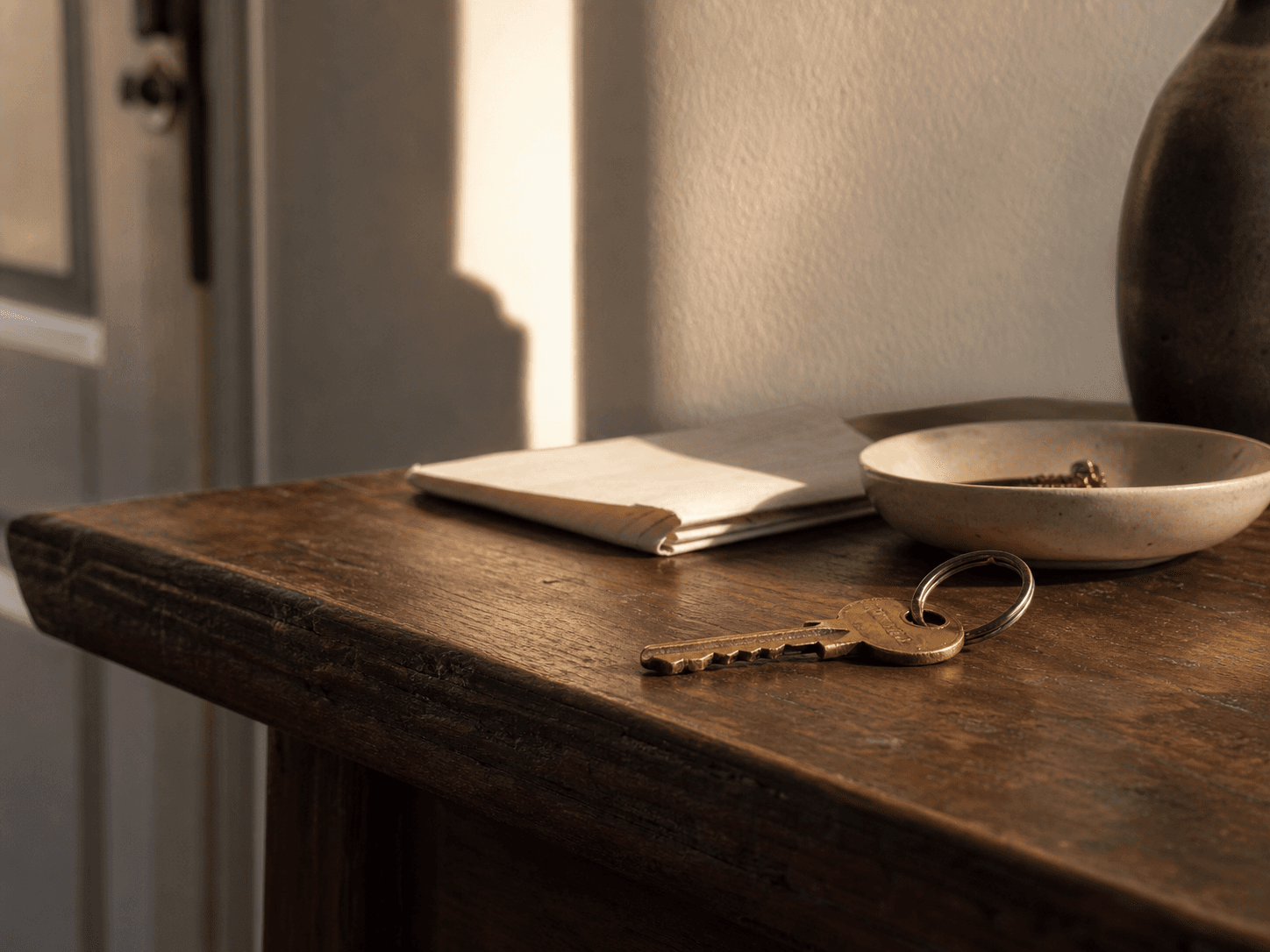
It lives somewhere irrational: a drawer with old batteries, a ceramic bowl near the door, the inner pocket of a bag you no longer carry but cannot quite throw away. It is small enough to disappear and heavy enough to accuse.
You do not use it. That would be insane. You are not a criminal. You are not dramatic. You are simply a person with a minor archive of access.
Still, it remains.
The Object Itself
House keys are among the least glamorous objects we carry, which is why they become so intimate. They do not flatter. They do not perform taste. They are cut to fit one particular absence in one particular door.
A key is a map made of metal. Its teeth remember a lock better than you remember the hallway. The small scratches along its edge are not decoration, but evidence: years of missing slightly, entering tired, coming home late, leaving in a mood, turning back because you forgot the thing you meant not to forget.
The key knows your hands at their least theatrical. Cold. Full of groceries. Holding flowers. Holding nothing. Trembling once, maybe. Trying to be quiet.
This is why old keys feel different from other obsolete objects. A dead phone charger is junk. A loyalty card expires without ceremony. But a key from a former life retains the shape of permission.
The Ritual of Being Given One
To be given a key is to cross a threshold before the threshold. The moment rarely announces itself with the gravity it deserves. No one lights candles. No one says, "I am now making you infrastructural to my life."
Usually, it happens casually.
"Here," they say. "Just in case."
Just in case is one of the great phrases of intimacy. It pretends to be practical while quietly handing over belonging. Just in case you arrive before me. Just in case I am in the shower. Just in case you are no longer a visitor.
Suddenly, your body learns another route. Another buzzer. Another drawer where the spoons live. Another way a door sticks in summer. Another apartment's private climate.
The key makes you eligible for ordinary things. That is its power. Not sex. Not drama. Ordinary things.
Watering plants. Letting yourself in. Waiting on the sofa. Hearing the lock turn from the other side and not needing to stand up.
The Geography of Former Access
The key you still have belongs to a door you can picture too clearly.
Maybe there was a narrow stairwell. Maybe the lobby smelled faintly of rain and radiator heat. Maybe the hallway carpet had a pattern so ugly it became comforting. Maybe there was a plant by the door, heroic in its refusal to die.
You remember the sound before the opening. The little resistance, the turn, the release. Locks have signatures. Some are crisp. Some are sticky. Some make you lift the handle first, a small secret of entry you once learned with the tenderness of someone being trusted.
The address may no longer be yours in any meaningful way, but the hand remembers.
That is what makes the object dangerous. Not because you might use it. Because you still know how.
Why We Do Not Throw Them Away
We keep old keys because they are too specific to be trash and too useless to be tools. They occupy the most difficult category of object: emotionally functional, practically absurd.
A photograph tells you what happened. A key tells you what was possible.
This is why it resists disposal. To throw away the key would be to admit the door is not merely closed, but irrelevant. That the route is gone. That the version of you who could enter without knocking has been archived.
Most of us prefer ambiguity. We like an object that lets the past remain technically accessible, even if morally, socially, and legally it is not.
So the key stays. Not as hope. Hope is too dramatic. It stays as a tiny exception to finality.
The Ethics of the Duplicate
There is also the question of whether you should still have it.
Probably not.
There are clean people in the world who return keys promptly, along with books, sweaters, chargers, and emotional clarity. They place things in envelopes. They label. They behave as if endings are logistical and can be handled during business hours.
The rest of us discover a key months later and stand very still.
You consider mailing it. Then you imagine the note. Too formal? Too intimate? "Found this" sounds dishonest. "Thought you should have it" sounds prosecutorial. No note sounds psychotic.
So you put it back.
Not forever. Just not today.
The Key as Talisman
There is an older, stranger dimension to keys. Across cultures, keys have stood for protection, access, authority, secrecy, passage. Saints hold them. Jailers hold them. Hotel clerks once handed them over with ceremony. A key is never neutral. It either grants or refuses.
The one you still have grants nothing now, except memory.
But memory is not nothing.
It carries the weight of a life in which you knew the code, entered the building, put your coat on the chair, opened a cabinet without asking. A life where someone had made space for your arrival and your absence had not yet become easier than your presence.
That is why the key feels warm even when it is cold.
When to Let It Go
There does come a time.
Not always with drama. Not always after closure, that overrated administrative fantasy. Sometimes you find the key and feel, for the first time, nothing performative. No ache. No spark. No imaginary hallway.
Just a piece of brass.
That is when it can leave.
You can return it, recycle it, drop it in a drawer of miscellaneous metal and allow it to lose its biography among Allen wrenches and old luggage locks. The method matters less than the shift. The spell has ended because you no longer need the object to hold the door shut behind you.
Until then, perhaps it is fine to keep it.
Not as a plan. Not as permission.
As evidence that you once belonged somewhere specific enough to be cut into metal.
A key is not the past.
It is the shape the past took when it still opened.